
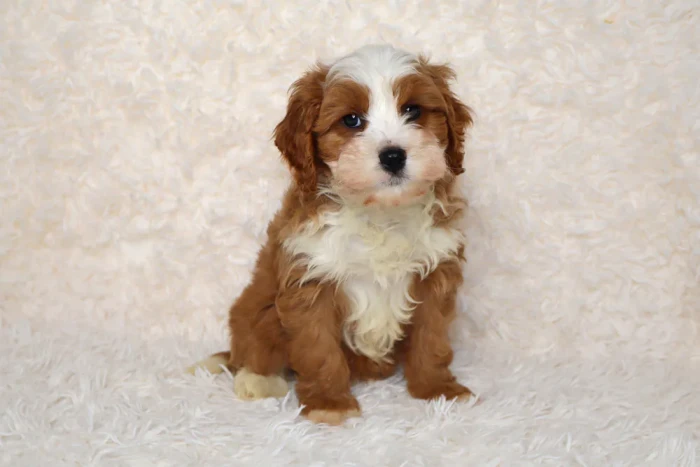
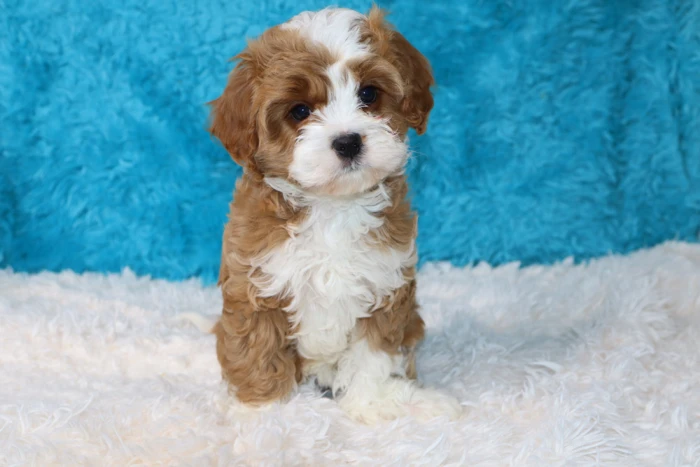

Cavapoos For Sale In New York City, New York
Cavapoos suit city life in New York City well.
City dog parks in New York City stay usable through every season. January highs average around 38 degrees and the area gets around 32.5 inches of snow a year. A Cavapoo goes out in cold and snow without any difficulty. With 224 sunny days a year, city dog owners get plenty of comfortable time outside through spring, summer, and fall. New York City is in New York Metro Area. For families in New York City searching for Cavapoo puppies for sale, the breed and the city climate work together.
Available Cavapoo Puppies For New York City, NY
All Cavapoo puppies displayed here can be delivered right to your door in New York City, NY.
Cavapoos in New York City
A Cavapoo coat needs professional grooming on a regular schedule. F1 coats need an appointment every 12 to 14 weeks and F1b coats every 6 to 8 weeks. In a cold place like New York Metro Area, the breed's hair goes through changes from the damp of spring thaw to the dry cold of winter. Consistent appointments through the year keep the dog in good shape no matter what the weather is doing. The breed is low-shedding, which means less hair in the home year round. That is one of the practical advantages of owning a Cavapoo in any climate.
Is a Cavapoo the Right Dog for Your Home?
Most families who bring home a Cavapoo find that it slots into the household’s daily rhythm within the first few weeks, with no structured exercise plan or behavior management routine required. The dog wants to be near its people, matches its pace to whatever is happening around it, and settles down quietly when the activity stops. Families in apartments, families with toddlers, families with packed schedules, and families without a yard have all found that the Cavapoo works for them because the dog adjusts to the household instead of the other way around.
Cavapoos generally weigh between 12 and 25 pounds when fully grown, which fits almost any living situation. A dog this size travels easily in the car, meets airline carrier requirements for in-cabin flights, and lives comfortably in a small apartment. Children can play with a Cavapoo and pick it up safely, yet the dog is solid enough that it doesn’t feel breakable the way some toy breeds do. Families who previously owned larger dogs often mention that food costs, grooming bills, boarding, and vet visits all become more manageable at this size without losing the feel of having a real dog rather than a fragile lap pet.
The Cavalier King Charles Spaniel side of the breed is where much of the personality originates. Cavaliers were bred for centuries as companion dogs, and that history produces an animal that is affectionate, gentle, and genuinely patient with children even when the household gets loud. Daily exercise needs land in the 30 to 45 minute range, which can be a walk, some yard time, or a play session indoors, and a Cavapoo that gets reasonable activity will happily curl up beside you afterward without pestering for more.
Every Cavapoo in our program is an F1b variation, and the reason matters once you understand what each generation produces. An F1 Cavapoo is a first generation Cavalier and Poodle cross, and while those dogs are wonderful, the coat type and shedding can be unpredictable from one puppy to the next. By breeding a first generation Cavapoo back to a Toy or Miniature Poodle, we produce an F1b with a curlier coat, significantly less shedding, and far better reliability for families with allergy concerns. The cross also brings forward more of the Poodle’s intelligence and trainability while keeping the Cavalier temperament intact. That specific combination, meaning Cavalier sweetness paired with Poodle intelligence in a 12 to 25 pound low shedding frame, is what the F1b generation is designed to deliver.
Cavapoos typically live 12 to 15 years, which gives most families well over a decade with the dog. For a household with young children, the puppy you bring home this year will realistically be part of the family through grade school and into the teenage years.
Grooming sits on a 6 to 8 week schedule, and this is often the part new Cavapoo owners underestimate. The wavy or curly coat doesn’t shed on the couch, doesn’t leave hair on your clothes, and doesn’t produce the dander levels that trigger allergies in most other small breeds. What it does require is regular attention. When the 6 to 8 week appointment slides to 10 or 12 weeks, mats begin forming close to the skin, particularly behind the ears, under the legs, and along the belly, and once those mats are established they are much harder to brush out than to prevent. Families who put the appointment on the calendar from the first week find it becomes routine quickly. The ones who treat it as optional usually figure out within a few months why it isn’t.
Getting Outside in New York City
New York City has good options for getting outside with your Cavapoo. The area has dog parks and trails that work well through most of the year.
Cavapoos are social dogs and getting them out regularly in New York City is good for the dog and easy on the owner. Families use dog parks for social contact and trails for a different kind of outing.
Dog Parks in New York City: Chelsea Waterside Dog Park, W 23rd St & 11th Ave (Hudson River Park), New York Pier 84 Dog Run at Hudson River Park, W 44th St & 12th Ave, New York
Trails near New York City: Hudson River Greenway, Battery Park to GW Bridge, New York Riverside Park Trail, Riverside Dr, W 59th-W 155th St, New York
Why Families Choose Blue Diamond Family Pups for Their Cavapoo
Seven People, Five Children, and Kimberly's Temperament Test of Every Puppy
A Cavapoo typically lives 12 to 15 years, and the dog you’ll spend those years with is largely determined long before you bring it home. Whether a doorbell sends the dog spinning or barely registers, how it handles a vacuum cleaner, how confident it is around strangers, and how quickly it bounces back when something goes wrong are not quirks the dog picks up in adolescence. They are wired in during a narrow developmental window in the first weeks of life, and once that window closes, the foundation is set. Blue Diamond runs Early Neurological Stimulation (ENS) on every Cavapoo puppy from day three through day sixteen, using a daily protocol of brief, controlled handling exercises performed during the exact period when the nervous system is most responsive to shaping. The science behind it has been around for decades and was originally developed for working dogs that needed measurable resilience. Most companion-dog breeders skip it, but we have seen what it produces in the finished dog and consider it essential to the program.
Dean and Esther live on a 10-acre farm in Sugar Creek, Ohio, with five kids who help raise every litter from the day the puppies open their eyes, and that detail matters more than it might sound. Cavapoos are bred to be people-focused dogs, and a Cavapoo that has only known one or two adults for the first eight weeks of life is a different animal than one that has been carried, talked to, and played with by children of varying ages every single day. Our Cavapoo puppies grow up in a kennel surrounded by the normal sounds of a working farm and a busy household, including kids coming and going, other dogs barking, doors slamming, and dishes clattering. By the time they go home, none of it fazes them, so the first week in your house is not the first week the puppy has experienced real life.
Each Cavapoo puppy is individually assessed by Kimberly, a certified trainer, before it is ever posted on the website, and she doesn’t write a one size fits all blurb for the litter. Instead, she spends time with each puppy and produces a written behavioral profile for that specific dog, noting how it handles being picked up, how it reacts to a sudden noise, whether it follows a person around the room or wanders off to explore on its own, and how long it takes to settle after something exciting happens. That profile is what you read on the listing, which means you are not looking at a generic Cavapoo description and hoping the puppy in the picture matches it. You are reading an evaluation of the actual dog you’re considering.
This matters because Cavapoos vary more within a single litter than people realize. The breed has a reputation for being sweet and easygoing, and most of them are, but that description covers a lot of ground. One puppy in a litter might be the social butterfly who wants to greet every visitor and sleep on every lap, while another from the exact same parents might be more reserved at first, slower to warm up, and the kind of Cavapoo that becomes deeply bonded to one or two people and is content to follow them quietly around the house. A family with three young kids and a constant flow of guests is going to have a better time with the first puppy, while a retired couple looking for a steady, calm companion may genuinely prefer the second. Neither dog is better than the other, but they are suited to different lives, and Kimberly’s evaluations are designed to help you find the Cavapoo that fits your household rather than the one that happened to take the best photo that week.
Both parent dogs in every Cavapoo pairing, meaning the Cavalier King Charles Spaniel side and the Poodle side, are health tested and genetically screened before they’re bred, with results published on each parent’s profile page. Cavapoos can inherit issues from either parent breed, including heart conditions from the Cavalier line and certain eye and joint conditions from the Poodle line, so this testing isn’t a formality. You can look at the results yourself and understand the pairing before you commit to a puppy. Each puppy goes home with up-to-date vaccinations, deworming, a microchip, a complete vet check from Sugar Creek Veterinary Clinic, and a one year health guarantee. Families who want the transition to be easier can also add a Heartbeat Puppy Pal, a toy the litter has been sleeping with that goes home smelling like the rest of the litter.
Blue Diamond partners with a small, vetted group of breeders in Ohio, and every partner is held to the same standards we hold ourselves to. They run the ENS protocol on the same schedule, complete the same health and genetic testing on their parent dogs, and send every puppy to Kimberly for evaluation before it is listed on the site. The program doesn’t get diluted depending on which farm produced the litter, which means a Cavapoo purchased through Blue Diamond comes through the same process from start to finish no matter whose farm raised it.
Nearby Cities
If you are not located directly in New York City, that is not a problem. Blue Diamond delivers and sells Cavapoo puppies to families throughout the New York Metro Area.
We raise more than just Cavapoo puppies. See all of our breeds and puppies in New York City.
Find Cavapoo Puppies In Major Cities Near You:
Find Cavapoo Puppies In Local Communities
Getting Your Cavapoo Puppy to New York City, New York
Most families looking at puppies for sale in New York City want the same two things answered first. Who raised this puppy, and how does it get to me?
We're a family of seven running a kennel on a working farm in Ohio, seven to nine hours west of the city. Every parent dog clears extensive health and genetic testing before it produces a litter. Once puppies are old enough, Kimberly runs an official temperament test on each one individually and writes the description herself. That's why no two of our listings read alike.
Everything we've got available is on the site, along with the litters coming up. See one you want first pick of and you can reserve it right here. Depending on the breed, expect somewhere between $2,195 and $4,595.
Ground transport leaves Ohio on Tuesdays in custom vans built for this. A vet checks every puppy over before the van pulls out, two drivers ride the whole route, and they call with an exact arrival time once they're close. Door to door anywhere in the five boroughs is $300.
Once your puppy arrives, winter delivery comes with some small considerations. If it's January or February, you have to worry about the winter snow. Ours go home litter-box trained rather than grass-trained, and teaching them where "outside" is takes longer when the ground is buried under the snow, which is about 32 inches in an average winter for New York City. Road salt is the other half of the equation. Just rinse their paws whenever you come back in, and by spring it'll be second nature.