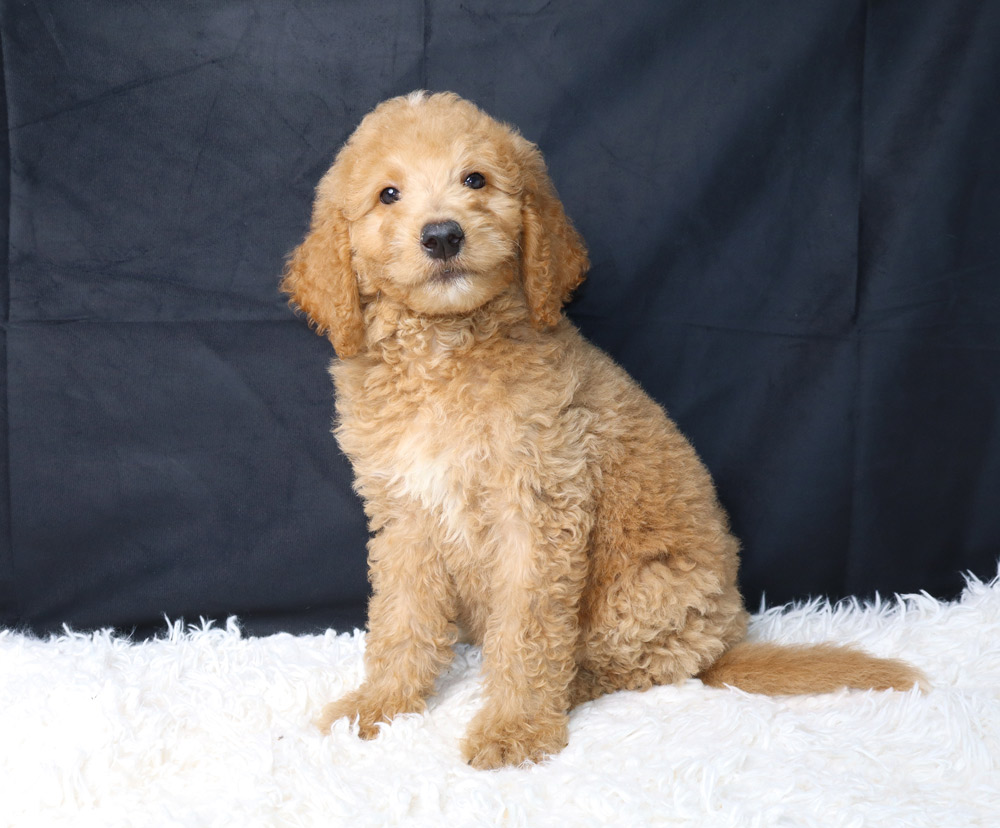
Standard Goldendoodle puppies at Blue Diamond come from English Cream Golden Retriever mothers paired with health-tested Standard Poodles. A puppy trainer evaluates each dog on its own, writes a full personality profile, and helps match every pup to the right home based on what she actually observed. We breed F1 and F1B generations. Prices run $2,000 to $4,000.
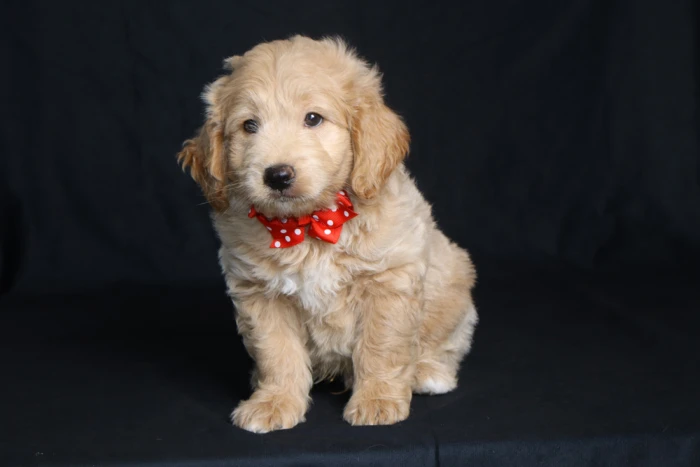
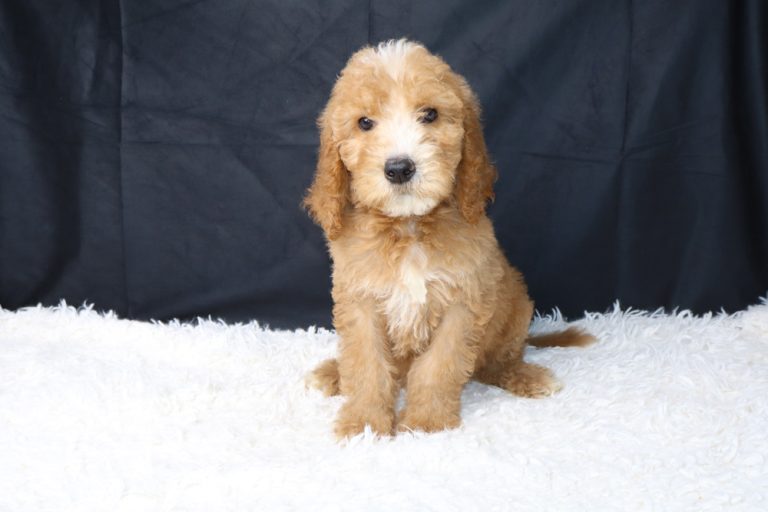
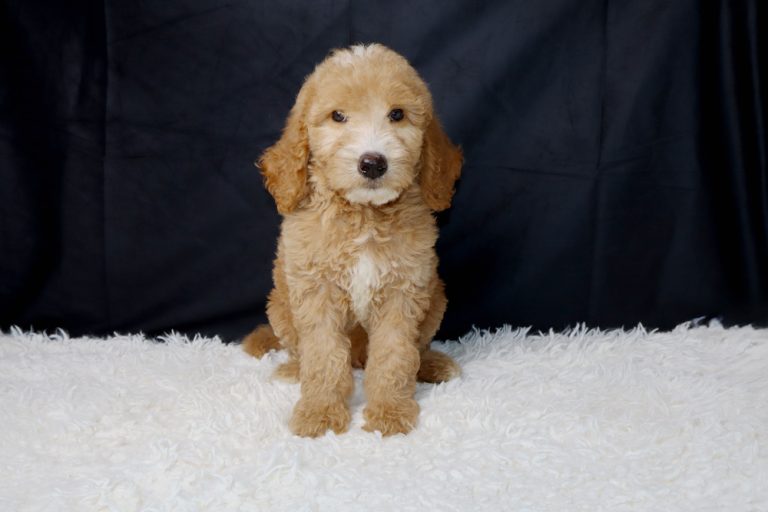
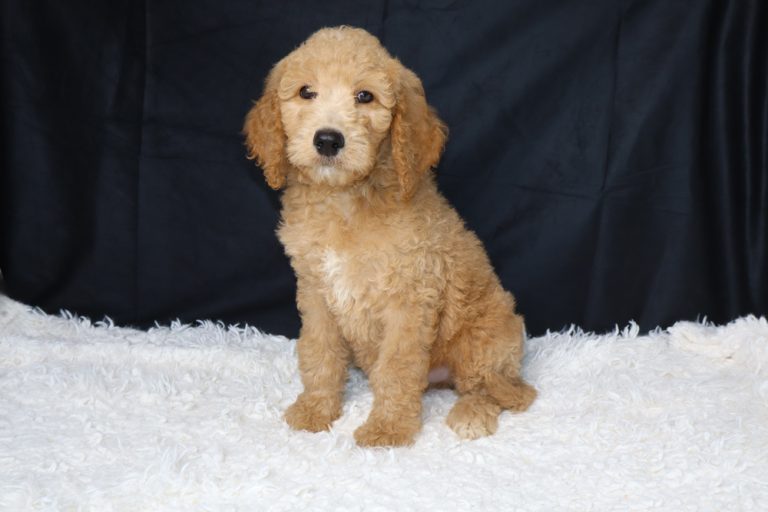
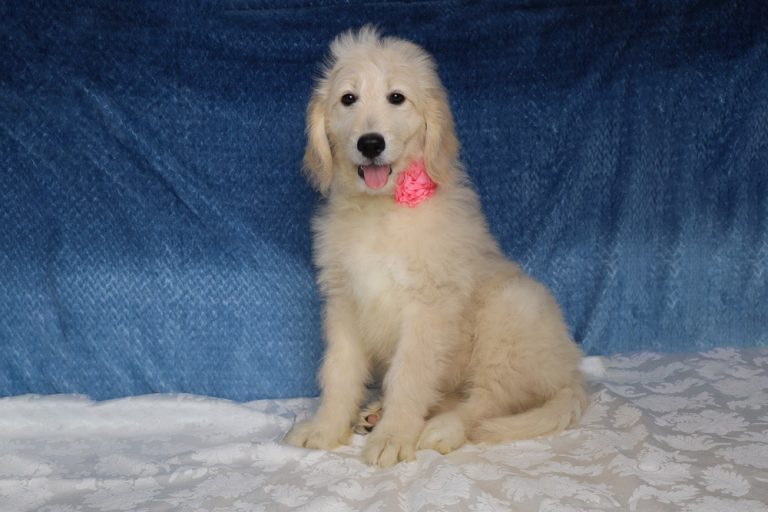
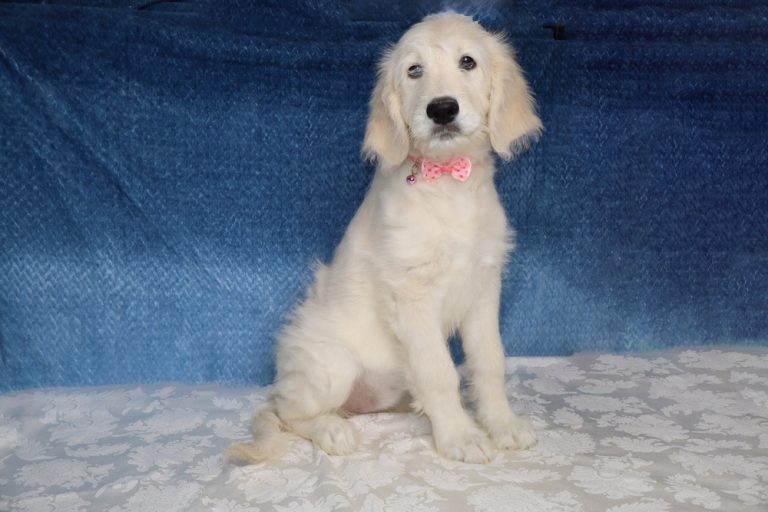
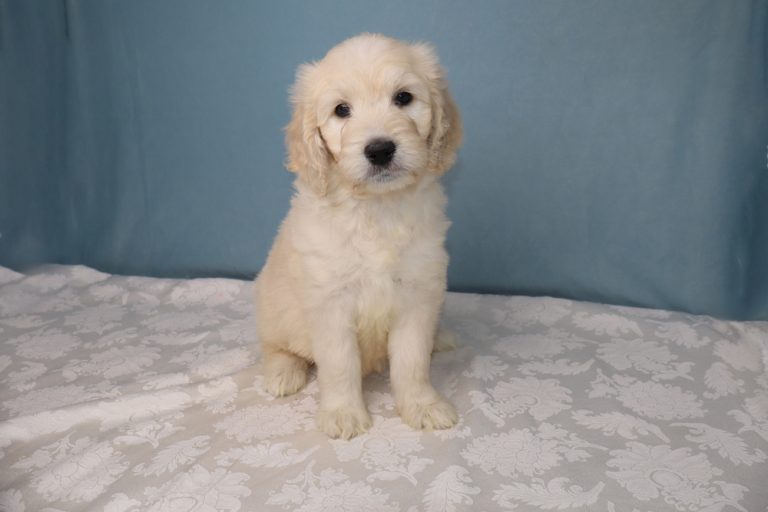
A Standard Goldendoodle is a cross between a Golden Retriever and a Standard Poodle. The word “Standard” points to the size of the Poodle parent, not to any formal kennel club designation. The breed caught on across the United States through the 1990s, after breeders started pairing Golden Retrievers with Poodles to combine the Golden’s friendly, people-loving nature with the Poodle’s brains and low-shedding coat. Standards are the largest of the Goldendoodle sizes. That size suits families who want a dog they can hike, swim, and run with rather than carry around.
At Blue Diamond we build our Standard program around English Cream Golden Retrievers. Goldens bred to American show standards tend to run slimmer and higher-strung. English Cream lines carry a stockier body, a blockier head, and a calmer disposition, and they pass those traits to their puppies. Pair that mother with a health-tested Standard Poodle and you get the foundation for a steady, long-lived family dog.
| Adult weight | 50 to 90 lbs |
| Height at shoulder | 21 to 26 inches |
| Lifespan | 10 to 15 years |
| Generation at Blue Diamond | F1 and F1B |
| Shedding | Light (F1) to minimal (F1B) |
| Coat | Wavy (F1) to curly (F1B) |
| Hypoallergenic | Semi (F1) to yes (F1B) |
| Parent breeds | English Cream Golden, Std Poodle |
For all that size, these are athletic dogs that still know how to settle. An adult Standard wants real activity during the day, then turns into a living-room dog once the exercise is out of its system. They want to be near their people far more than they want to roam a yard alone.
The generation label tells you the breeding makeup of the dog. That makeup predicts coat type, shedding level, and how strongly the Poodle side shows up in energy and grooming demand.
An F1 Standard Goldendoodle has one purebred Golden Retriever parent and one purebred Standard Poodle parent, which makes the dog 50% of each breed. F1 Standards usually land in the wavy coat range, shed lightly, and rate as semi-hypoallergenic. The Golden temperament comes through strongly at half the genetics, so F1 Standards tend to carry that warm, easygoing personality the breed is known for. This is the generation families pick when they want the classic blend and don’t have serious allergy concerns.
An F1B Standard Goldendoodle has one F1 Goldendoodle parent bred back to a purebred Standard Poodle, which shifts the math to roughly 75% Poodle and 25% Golden Retriever. The coat trends curlier and sheds less, so F1B Standards fit families with stronger allergy concerns. The extra Poodle genetics also bring a touch more energy and a higher need for mental work.
Both generations are affectionate, sharp, and built for family life. The choice usually comes down to allergies and how much grooming time a family wants to take on. F1B coats need brushing more often and groomer visits on a tighter calendar than F1 coats. Genetic testing on the parents lets us predict coat outcomes far better than the generation label does on its own, so ask us and we’ll tell you what a given pairing is likely to produce.
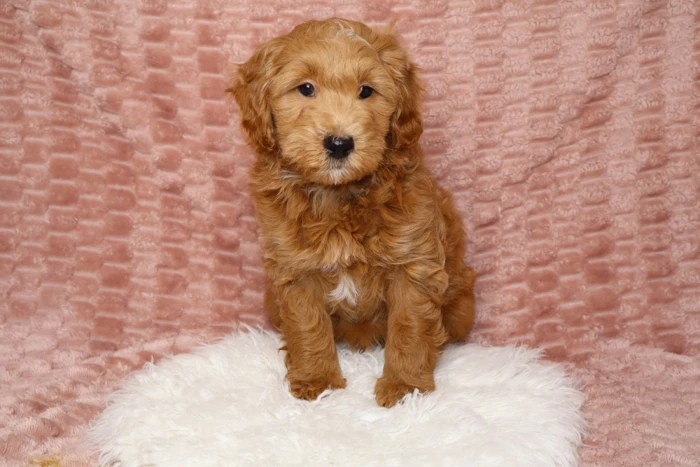
Standard Goldendoodles are friendly, loyal, and genuinely tuned in to their people. The Golden Retriever side brings a soft, social warmth. The Poodle side brings the intelligence that makes them quick to read a room and quick to learn. The result is a dog that wants to be part of whatever the family is doing, whether that’s a hike or an afternoon on the couch.
They do best in homes where someone is around for most of the day. Separation struggles are a real tendency with this breed, not a scare story. A Standard left alone for ten or twelve hours on a regular basis is more likely to develop barking, chewing, or general anxiety. Early training that builds comfort with alone time, starting the first week home, cuts that risk down a lot.
With children, Standards are patient and gentle. The catch is size. A happy 70-pound dog can knock a toddler flat without meaning any harm, so supervise play between big dogs and small kids and teach both sides how to handle each other. The breed itself rarely snaps or shows aggression. Families with kids who’ve learned to read a dog describe Standards as close to ideal.
Other pets are seldom a problem. Standards introduced to cats and other dogs early tend to slot right in. They greet hard and play hard, so if you already have a small or nervous dog at home, manage those first meetings closely.
Training comes easily to this breed. Both parent breeds rank near the top for intelligence and willingness to please, and Standards inherit both. They’re sensitive dogs, so harsh correction backfires and tends to shut them down. Short, upbeat sessions with treats and praise get you a well-mannered dog faster than long drills ever will.
Adult Standard Goldendoodles at Blue Diamond run 50 to 90 pounds and stand 21 to 26 inches at the shoulder. Males sit at the larger end, commonly 65 to 90 pounds. Females usually land between 50 and 70 pounds. The weights of both parents drive where a given puppy ends up, so we give each litter a size estimate based on the dam and sire.
| Age | Estimated weight range |
|---|---|
| 8 weeks (go-home age) | 8 to 14 lbs |
| 3 months | 18 to 28 lbs |
| 6 months | 35 to 50 lbs |
| 12 months | 45 to 75 lbs |
| Full grown (18 to 24 months) | 50 to 90 lbs |
A Standard hits most of its height by around 12 months, then keeps filling out with muscle and width for another six months to a year. Plenty of Standards aren’t fully mature until 18 to 24 months. Because they grow into a big, sturdy dog, plan crate, car, and gear purchases around the adult size rather than the puppy in front of you.
Standard Goldendoodles carry two main coat types depending on generation. F1 Standards usually have a soft, wavy coat that reflects a balance of both parents. F1B Standards run curlier because of the heavier Poodle influence. Both shed little, but the F1B coat holds loose hair more tightly and releases less dander, which is why allergy-sensitive families lean that way. The tradeoff is grooming. Curlier coats mat faster and ask for more brushing and more frequent groomer visits.
A straight or flat coat shows up now and then, almost always in F1 litters, and looks more like the Golden Retriever parent. Straight-coated Standards shed more than wavy or curly ones. Testing the furnishing gene on our parent dogs lets us steer away from the improper-coat outcome that sheds like a full Golden Retriever, so we can tell families ahead of time which puppies will carry the low-shedding doodle look.
Standard Goldendoodles come in a wide spread of colors pulled from both parent breeds:
Many Standards change color as they grow up. Apricot and red puppies often lighten, and dark coats can fade toward silver. The best read on an adult color comes from the parents and any older siblings from past litters. Most of our Standards come out cream, apricot, or red, which the English Cream side drives. We don’t breed for merle. Full descriptions and photos go live with each puppy’s listing at seven weeks old.
Goldendoodles benefit from hybrid vigor, the tendency of a first-generation cross to come out healthier than either purebred parent. That’s a tendency, not a promise. A Standard can still inherit problems from either side, which is why we run genetic health testing on every breeding dog before it enters the program. Below are the conditions that matter most for this breed.
Hip dysplasia is the joint condition to watch most closely in a Standard Goldendoodle, mostly because of the Golden Retriever side. It affects up to 20% of Golden Retrievers and a smaller share of Standard Poodles. The hip joint forms loosely and wears badly over time, which shows up as trouble rising, hesitation on stairs, or a limp after exercise. Elbow dysplasia is the same idea in the front legs. Responsible breeders screen both parents through OFA or PennHIP before pairing. Keeping a young Standard at a lean weight and off hard-impact jumping while the growth plates are still open protects those joints during the years that matter most.
Progressive retinal atrophy is an inherited eye condition carried by both parent breeds. It slowly destroys the retina and ends in blindness. A DNA test on the parent dogs flags carriers and keeps the pairing from producing affected puppies. Every Blue Diamond breeding dog is tested for PRA.
Von Willebrand disease is a blood-clotting disorder that can come from either side of the cross. A dog with it bleeds longer than it should from minor injuries or routine surgery. The condition is DNA tested. We screen both parents and pair around it.
Golden Retrievers carry higher rates of certain cancers than most breeds, and that risk is one of the main reasons we built our program on English Cream lines. English line Goldens have shown lower cancer rates and a longer average lifespan than American show lines. Crossing with a Standard Poodle lowers the odds further, though no cross removes the risk entirely. Annual vet visits and prompt attention to new lumps or sudden weight changes give you the best shot at catching trouble early.
Bloat, or gastric dilatation-volvulus, is a fast and dangerous emergency in large, deep-chested dogs like the Standard. The stomach fills with gas and can twist. Feeding two or three smaller meals across the day instead of one big bowl reduces the risk, and so does keeping hard exercise away from mealtimes. Learn the warning signs, a swollen belly and unproductive retching, because bloat is a same-hour trip to the vet.
Standard Goldendoodles inherit floppy ears that trap moisture more readily than upright ears do. That trapped moisture is what yeast and bacteria need to take hold. Check the ears weekly and clean them with a vet-approved solution when you see wax or catch a mild odor. Head shaking, scratching, redness in the canal, or a strong smell all warrant a closer look.
Dental disease creeps up on dogs of every size when nobody’s brushing. Daily tooth brushing slows plaque, dental chews help between brushings, and a veterinary cleaning on your vet’s schedule catches problems before they turn into extractions.
Every Blue Diamond puppy leaves with a veterinary health certificate, age-appropriate vaccinations, a deworming record, and the parent health-testing paperwork. Blue Diamond’s health guarantee covers genetic health conditions for one year from the date of purchase.
A Blue Diamond Standard Goldendoodle doesn’t run a plain whelping-box-to-go-home routine. What happens in the eight weeks between birth and pickup shapes how the puppy handles its first week in a new house, and a lot of what comes after that too.
ENS starts on day 3 and runs through day 16. Each puppy gets five specific handling exercises once a day during that window: tactile stimulation, thermal stimulation, head-up positioning, head-down positioning, and supine positioning. The protocol came out of military working-dog research, which found that mild, controlled stress in that early neurological window produces dogs with stronger hearts, steadier stress responses, and more adaptability to new places. A Standard that’s been through ENS takes its first car ride, first vet visit, and first night in a strange home with more composure than one that skipped it.
Kimberly, our independent puppy trainer, evaluates every puppy at seven weeks. She works through each dog on its own across several traits, including energy level, response to handling, reaction to new people and other dogs, and how it takes being held. Then she writes a full personality description, and that report posts on the website alongside the puppy’s listing. Families choosing a Standard from Blue Diamond don’t get a recycled breed blurb. They get a read on the specific dog they’re looking at.
Between the ENS window and Kimberly’s evaluation, each puppy spends weeks being handled by different people, exposed to household sounds, moved through new spaces, and introduced to other dogs. By pickup day, these aren’t puppies that have only ever seen one room.
Puppies post on this page as soon as Kimberly finishes temperament testing at seven weeks. Sign up for the newsletter and you’ll hear the moment a new litter goes live. Standard litters move quickly once the listings are up.
Any puppy with a price listed is available now. Clicking Details on the listing opens Kimberly’s full temperament profile, covering the puppy’s energy level, how it reacts to new people and dogs, and the training approach she’d recommend for that animal. Reserving takes a deposit. Reach out through the contact page and we’ll walk you through the steps.
Puppies go home at eight weeks. No puppy leaves before that, whatever the family’s preference or schedule. Eight weeks is the point where a puppy is ready to leave its litter, take in new surroundings, and start bonding with a new family without lasting stress. That’s our standard and we don’t bend it. For families outside driving range, Blue Diamond connects you with vetted transporters who specialize in safe puppy delivery, and flight nanny options are available in some cases. Your puppy leaves with its health certificate, vaccination record, deworming documentation, Kimberly’s written temperament profile, and the litter’s parent health-testing paperwork.
An adult Standard Goldendoodle needs 60 to 90 minutes of activity a day, ideally split across a couple of outings. Two solid walks plus a play session covers the physical side for most dogs. These are athletic animals that love a hike, a swim, or a long game of fetch, and they’re happiest moving alongside their family rather than running laps alone. Pair that physical work with some mental work, training drills or puzzle feeders, and a Standard settles nicely once the day’s energy is spent. Skip the exercise and that energy turns into chewing and barking.
Puppies need far less planned exercise than adults. The common guideline for large-breed puppies is five minutes of leash walking per month of age, twice a day. A four-month-old, then, gets about two twenty-minute walks. That limit protects joints that are still forming. Hold off on long runs, repeated stair work, and jumping until the dog is closer to 18 months, when the growth plates have closed.
F1 Standard Goldendoodles need brushing three to four times a week and a professional groom every eight to ten weeks. Their wavy coats run a little lower-maintenance than the curlier type, but they still mat without attention, especially behind the ears and under the legs where the coat rubs.
F1B Standards need brushing four times a week or daily and a professional groom every six to eight weeks. The curlier coat holds loose hair instead of dropping it, which is great for allergies and rough on tangles, because those mats have nowhere to go unless you brush them out. A slicker brush paired with a metal comb is the combination that works. Start brushing during the first week home so the dog learns to stand for it as an adult.
The coat grows continuously and doesn’t shed itself clean, so a neglected Standard mats fast, and a badly matted dog ends up shaved at the groomer rather than trimmed. Ear care is part of the routine too. Check the ears weekly and clean them with a vet-approved solution when you see wax or smell anything off. Trim nails every two to three weeks.
Feed your Standard Goldendoodle a large-breed dog food matched to its life stage. Large-breed puppy formulas hold calcium and phosphorus at the levels a big, fast-growing dog needs, which matters for joint development. Puppies eat three to four meals a day until about four to six months, then drop to two or three. Adults do best on two meals a day, morning and evening. One large daily meal raises the bloat risk in a deep-chested breed, so avoid it.
A typical adult Standard eats two to four cups of dry food a day depending on weight, activity, and the food itself. Check the guide on your bag and adjust to body condition. A lean Standard lives longer than a heavy one. We send each puppy home with the food it’s been eating so the switch doesn’t upset its stomach, and we’ll tell you the brand and the amount at pickup.
Standards are among the easier large breeds to train. The Poodle’s intelligence and the Golden’s eagerness to please combine into a dog that picks up commands fast and likes the work. Short sessions beat long ones. Ten or fifteen minutes twice a day, with varied drills and positive reinforcement, gets you further than one long slog. Start the day your puppy comes home. Sit, stay, come, and down land within a few weeks for most pups.
Build alone-time tolerance from the first week, because this breed leans toward separation anxiety. Leave the puppy on its own for short stretches and stretch them out gradually. Crate training helps, since a defined safe space is easier on a dog than the run of a house that feels too big when you’re gone. A positive puppy class around 10 to 12 weeks is a strong next step, and the AKC S.T.A.R. Puppy and Canine Good Citizen programs are open to Goldendoodles through AKC Canine Partners.
Posted on Google
 Helen GomezSeptember 30, 2026
 Wonderful people who love their dogs and train/care for them with incredible patience and concern for their mental and physical health using the latest techniques and protocols! They are also pretty patient with the humans that have a million questions and concerns! We LOVE our new fur baby and our home is all the better for our mini Bernedoodle, Beany Baby! Helen GomezPosted on Google
 Nancy ArchambaultSeptember 30, 2026Wow I couldn’t be happier with my Cavapoo puppy, Ernie! Blue Diamond is an A-one company and delivers everything they promise! I would highly recommend Blue Diamond to anyone wanting to add a furry friend to their family! Ernie was so well-adjusted to my 2 other Cavapoos and my cat and slept in bed with us from day 1. I truly appreciate that Blue Diamond has their own courier service that they contract with because Ohio is quite a drive from Wisconsin and with gas prices what they are… Thanks again for Ernie!Posted on Google
 John EasleySeptember 25, 2026We have had our girls for nearly three years now. They became part of our family the day they arrived and continue to give us joy everyday. Dean and the Blue Diamond Family Pups family have continued their support and are prompt in replying with continued assistance anytime we reach back. Highly recommend. Lt Col John and Heather EasleyPosted on Google
 Mel T.September 8, 2026Finn ( Asher ) is a F1 B cavapoo. ( zero shedding he can be in my lap in all black and get off me with two dog hairs on my clothes ) He’s right at three months old. He has been a complete joy. He is super smart. I take him everywhere. He is the talk of the town. So many people will come up to us out in public. I have actually referred this breeder multiple times to people. There are so many scams out there. Also, the delivery process was first class. I knew about this breeder because a friend of mine had gotten a dog from them top-notch.Posted on Google
 Richard SermonsSeptember 5, 2026My wife and I have never ordered a dog online before so we were a little worried about the process. Blue Diamond Family Pups made the process very easy, they answered all our questions and kept us up to date with the delivery. They were very professional and We would highly recommend them for you ur puppy purchase. We received Roper on Thursday morning and a day and a half later he has settled in here in his new Louisiana back yard. Thank You Blue Diamond Family Pups.Posted on Google
 JohnSeptember 4, 2026Very Professional and clean beautiful puppysPosted on Google
 Carolina AcevesAugust 28, 2026So happy with our experience finding our Bernese Mountain Dog. We got our puppy in March and had a seamless experience. He is a happy, loving healthy puppy.Posted on Google
 Kiara PeñaAugust 16, 2026We had a wonderful experience with Blue Family Diamond Pups (Dean and Heidi)! We found them through Reddit threads and Facebook groups when searching best bernedoodle breeders with great reviews. They responded to our email and text inquiries within hours and answered all of our questions. We purchased a 9-week-old F1 Standard Bernedoodle and had him transported from Ohio to Miami. On their website they share videos of their 10-acre farm and facility, a tour of the third-party pet transport vehicle, and provided all of his documents and paperwork. We’re so happy with our puppy and would absolutely recommend Blue Family Diamond Pups! 🐶❤️Posted on Google
 Erin ScarpaceJuly 18, 2026we got spirit from you in November. She was3 months and a micro bernedoodle. She has been amazing. Her demeanor is so great. So many people have asked about your company and the breed because of her. Her colorings are amazing and everyone comments on it. She has been the sweetest best pup for our family. I hope more families find you all. Thanks again for an amazing dog.Posted on Google
 Kim CassettiJune 17, 2026We are so happy with Blue Diamond Family Pups! They were so responsive and helpful with all of my questions. We had our wonderful puppy shipped from Ohio to California. It all worked out so well! Incredibly grateful for Blue Diamond !!! Highly recommend!!!Posted on Google
 Richard ArthurMay 19, 2026There are no signs or markings identifying Blur Diamond, but Google maps got is to the front door.Posted on Google
 Justin EnnisMay 7, 2026We recently got a mini Bernedoodle named Drake from Blue Diamond Family Pups and had a great experience. We were nervous about buying a dog online and having him shipped, but the positive reviews gave us confidence — and it worked out perfectly. Drake has an incredible temperament, is great with our kids, and has been an awesome addition to our family. Highly recommend!Posted on Google
 Katherine WaltenMay 5, 2026After being scammed prior to finding Blue Diamond Family Pups, we cannot praise these folks enough. They worked with us due to our previous experience with scammers and we are forever grateful. We have a story to share: We have a show in Vegas. Daphne came to the Vegas theater with us the first evening since we had a show the day she arrived. She did fabulously. During our show, she started crying and howling just a little bit, but the audience could hear her. So my husband told them about her arrival. They started chanting to bring her on stage, so she made her stage debute on the first day with us! The audience left and we were just standing at the entrance door talking when some audience members returned and my husband thought they came back to see him. They said, no, we want to see Daphne!! 😆 On night 1 she was totally adjusted and is already a theater doggy!! On day 2, she was in a café with us! She is amazing and very smart! The nurturing and care provided by Blue Diamond Family Pups prior to delivery is a testiment to the care they provide the pups. Daphne is well adjusted, happy, content and very easy to train. If you are considering a pup from this place, do it. You will be so glad you did.Posted on Google
 Jim BeallMay 2, 2026These people are the " real deal". They worked with me through my apprehension about buying on-line. I got the love my life( a female standard Bernedoodle). A Great dog, from good people, for a far price. They are worth your trust!Posted on Google
 Brooke RosierMay 1, 2026We adopted Dahlia (now named Birdie) and couldn’t be more in love. It was our first time getting a puppy online without meeting the breeder in person which was a bit nerve wracking but the team at Blue Diamond Puppies was very communicative and thorough, and clearly she had been well taken care of prior to her arrival. Our puppy is happy, healthy, gorgeous and very sweet. Thank you so much Blue Diamond!Posted on Google
 Pam BohannonMarch 23, 2026My puppy arrives on time and has been a great dog. The training at the Blue Diamond family Pups was a wonderful experience he is so friendly and social with other dogs and people. I highly recommend this organization to anyone who is looking.Posted on Google
 Jami McMullenMarch 21, 2026This is Autumn aka Auty! She is a Cavapoo. Her birth name was Patience. I have the most sweetest prettiest pup ever!! She is so funny and intelligent! Auty brings sooo much joy to our little family. The process of purchasing my pup was sooo easy! Everything went smoothly. Thank you Blue Diamond 💎Posted on Google
 Syl NisleyMarch 17, 2026Just a great place to buy your next puppy friend. Awesome peoplePosted on Google
 Sam TostiMarch 16, 2026Blue Diamond Family Pups exceeded every expectation. From helping us receive our puppy seamlessly, to letting us know what to expect and how to prepare, and most importantly for our new puppy. She arrived in perfect health, well groomed and taken care of, and her personality is spot on with her assessment. We are so lucky to have found them!Posted on Google
 Nicole ThammavongMarch 14, 2026Our cavapoo Peaches (formerly Bella) is over a year old now and has been an absolute dream! She loves to explore with her humans and never barks. She does well other dogs and people and has a perfect bill of health, also smart and easy to train. We had such an easy an experience with Blue Diamond and received regular updates about our baby before she arrived. Highly recommend :)
Browse the litters posted above or sign up for the newsletter to hear the moment new puppies become available. Blue Diamond Standard litters fill quickly once Kimberly’s temperament reports go live.
Prices run $2,000 to $4,000. Reach Blue Diamond through the contact page with any questions before you reserve.