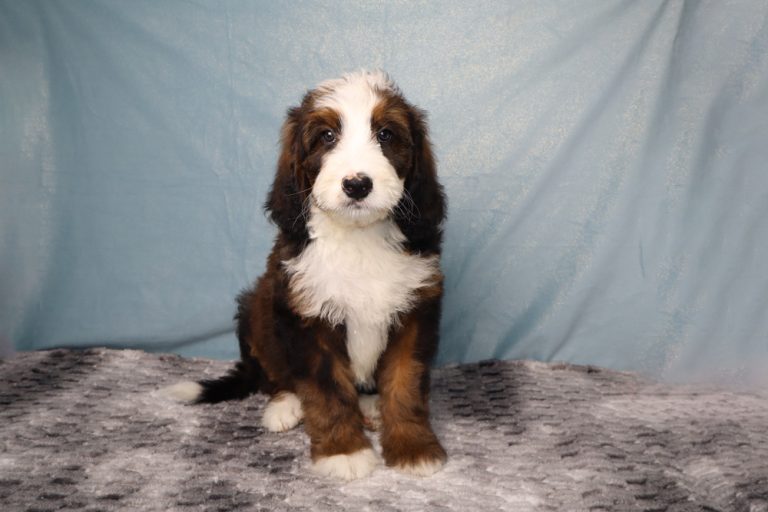
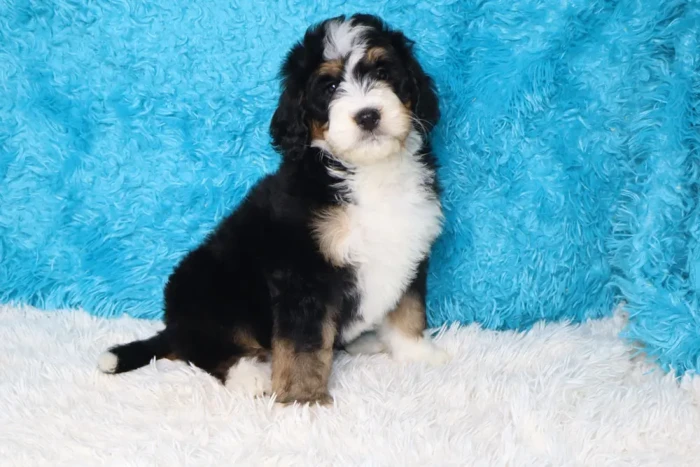
Every Blue Diamond Standard Bernedoodle puppy starts life with something most breeders skip entirely. A puppy trainer evaluates each dog individually, writes a detailed personality profile, and matches each pup to the right family based on documented temperament data. F1 generation only. Starting at $2,995.
05/08/2026
04/28/2026
A Standard Bernedoodle is a cross between a purebred Bernese Mountain Dog and a Standard Poodle. Sherry Rupke produced the first intentional pairing in Canada in 2003, combining the Bernese Mountain Dog’s calm loyalty with the Poodle’s longer lifespan and low-shedding coat. The breed lives up to the hype. That combination produces a large, affectionate dog that settles comfortably into family life without the high-strung energy of some other large breeds.
| Adult weight | 60 to 90 lbs |
| Height at shoulder | 23 to 29 inches |
| Lifespan | 12 to 18 years |
| Generation at Blue Diamond | F1 (50% Bernese / 50% Poodle) |
| Shedding | Minimal to none after first grooming appointment |
| Coat | Wavy to curly |
| Hypoallergenic | Yes — low dander |
Standard Bernedoodles sit in the medium-energy range. They’re not couch potatoes, but they’re not bouncing off the walls either. Most families describe their Standard Bernedoodle as a dog that wants to be near you at all times without demanding constant activity. That temperament balance is largely what’s driven demand for the breed over the past decade.
F1 stands for first-generation. An F1 Standard Bernedoodle has one purebred Bernese Mountain Dog parent and one purebred Standard Poodle parent, making the dog exactly 50% of each breed. Blue Diamond breeds F1 exclusively. All moms are purebred Bernese Mountain Dogs. Dads are Standard Poodles.
The generation label matters because it predicts the balance of traits your puppy is likely to inherit. F1b Bernedoodles are backcrossed with a Poodle. That pushes the genetics to approximately 75% Poodle and 25% Bernese Mountain Dog, which increases the likelihood of a curlier, lower-shedding coat but also moves the dog further from the calm, laid-back temperament that defines the Bernese Mountain Dog side of the cross.
Blue Diamond focuses on F1 because it preserves the traits families most want. It’s the right balance. You get the Poodle’s intelligence and low shedding paired with the Bernese’s gentle nature and loyalty, without sacrificing the calm, laid-back temperament that comes from keeping the Bernese genetics at 50%. Breeding back to a Poodle a second time trades that Bernese character for coat consistency. Most families working with Blue Diamond have done the research and specifically want the F1 balance.
Standard Bernedoodles are calm, affectionate, and deeply attached to their people. It shows up fast. They don’t do well in a yard alone or left in a kennel for long stretches, and the term ‘velcro dog’ comes up in nearly every conversation with Blue Diamond families after they’ve had their puppy for a few weeks.
Males tend to be more openly affectionate and physically demonstrative. Females lean slightly more independent but remain highly social with their families. The difference is subtle. Both sexes are gentle with children, easy-going around other pets, and unlikely to show aggression in normal household situations, which makes the Standard Bernedoodle one of the more forgiving breeds to bring into a home with regular visitors and mixed activity levels.
With strangers, Standard Bernedoodles are friendly but measured. They’re not guard dogs, and they won’t bark at every noise. When a new person enters the house, most will approach to sniff and warm up within a few minutes rather than retreating. That makes them well-suited for households with regular visitors.
Training is one of the breed’s strengths. Poodle intelligence shows up early, and Standard Bernedoodles pick up commands quickly with positive reinforcement. They can be slightly stubborn as adolescents, most often between 8 and 18 months, which is the developmental phase that catches some first-time owners off guard because the dog that was easy to handle at 12 weeks suddenly has opinions at 10 months. Starting obedience work at 10 to 12 weeks makes a real difference in how smoothly that phase goes.
Adult Standard Bernedoodles at Blue Diamond run between 60 and 90 pounds and stand 23 to 29 inches tall at the shoulder. Males run larger than females on average. The specific size of a given puppy depends on the size of both parents, so Blue Diamond can give families a reasonable estimate for each litter based on the dam and sire’s weights.
| Age | Estimated weight range |
|---|---|
| 8 weeks (go-home age) | 8 to 15 lbs |
| 3 months | 20 to 30 lbs |
| 6 months | 40 to 55 lbs |
| 12 months | 55 to 80 lbs |
| Full grown (18 to 24 months) | 60 to 90 lbs |
Standard Bernedoodles reach their full height around 12 months. They continue filling out in muscle and body mass until 18 to 24 months, which means the dog you bring home at 8 weeks will look noticeably different at two years than it does at one. Body weight continues filling out after height levels off. Most families buy a 42-inch crate at go-home and find it still fits the adult dog well.
Across Blue Diamond’s three Bernedoodle sizes, the Standard is the largest. Mini Bernedoodles run 25 to 50 lbs. Micro Bernedoodles fall under 25 lbs. If you’re sitting between sizes and want a side-by-side breakdown of weight ranges, energy levels, grooming time, and space requirements, the individual breed pages for the Mini and Micro walk through each in full detail.
Coat texture in a Standard Bernedoodle lands somewhere on a spectrum from wavy to curly. Wavy coats come from a more balanced expression of both parent breeds. Curly coats reflect a stronger Poodle influence in the coat genetics. Both textures shed minimally, and shedding drops further after the puppy coat transitions out following the first grooming appointment, around 6 months of age.
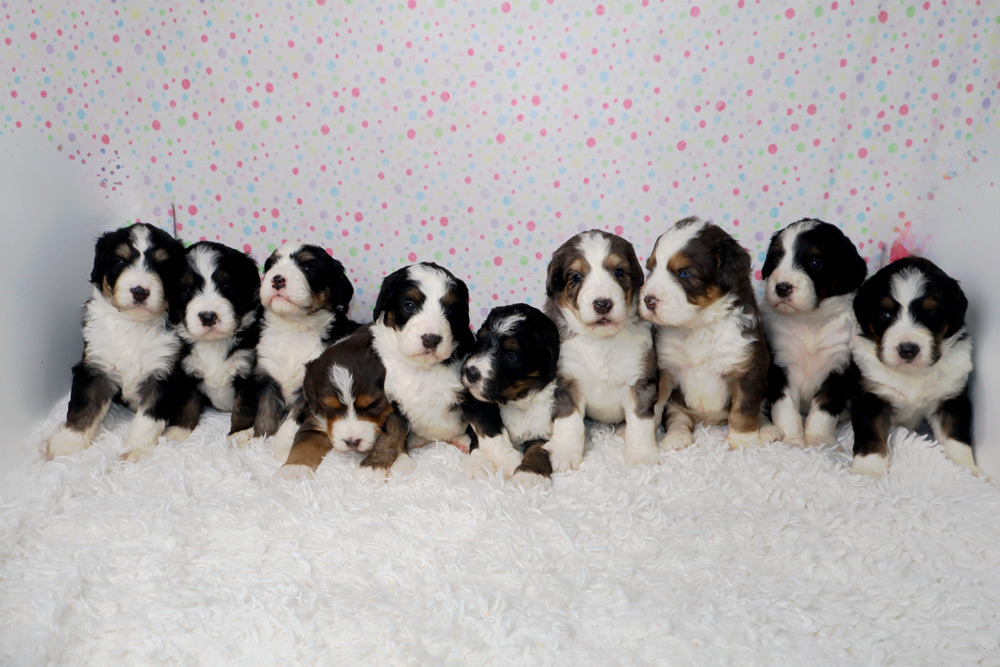
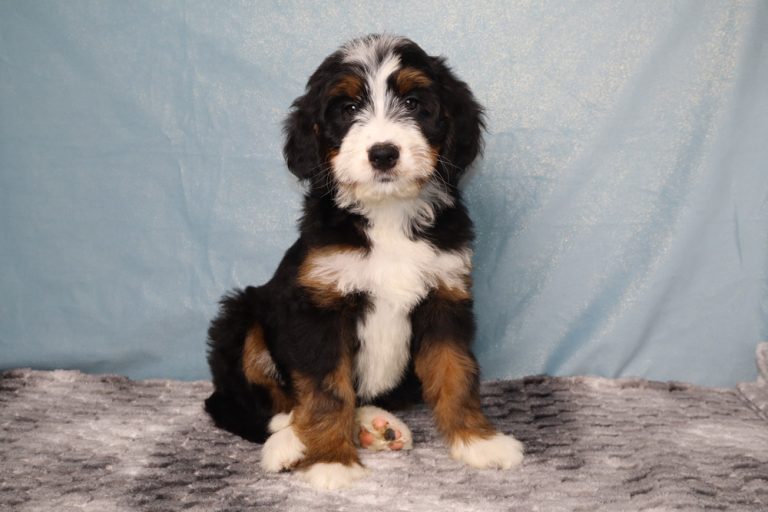
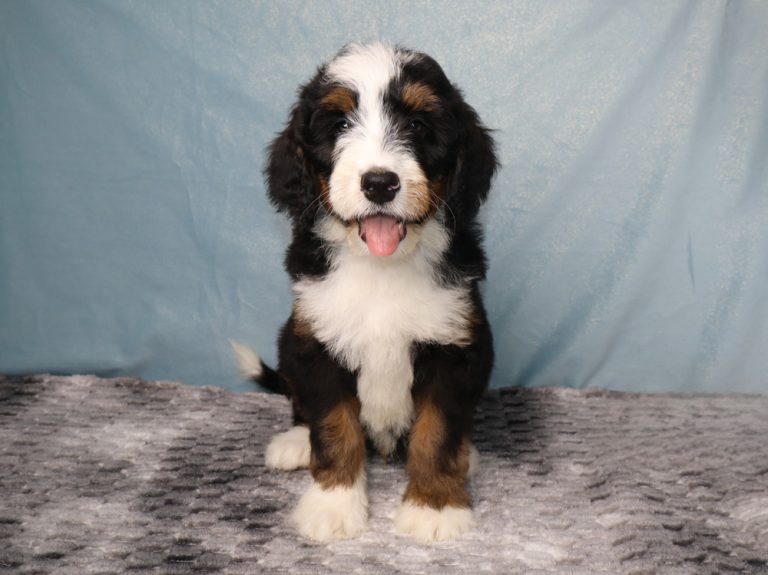
Blue Diamond Standard Bernedoodles come in several color patterns:
Kimberly confirms each puppy’s coat color at the temperament evaluation, which takes place around 7 weeks of age. Family profiles and descriptions go live on the website at that point.
All Blue Diamond Standard Bernedoodle coats require regular grooming. A 12 to 16 week grooming schedule prevents matting. Daily brushing between appointments keeps the coat in good condition and makes each grooming appointment faster and less stressful for the dog.
Standard Bernedoodles benefit from hybrid vigor, which is the tendency of first-generation crosses to be healthier than either purebred parent on its own. That’s one reason Blue Diamond breeds F1 Bernedoodles specifically. Still, large breeds carry specific health risks that responsible breeding addresses directly through parent health testing.
Hip and elbow dysplasia are the primary orthopedic concerns in large-breed dogs, and Standard Bernedoodles carry the same susceptibility as any other large breed where the hip and elbow joints bear heavy bodyweight load through puppyhood and adolescence. Both conditions involve abnormal joint development that causes pain and reduced mobility over time. Health testing of breeding dogs before pairing addresses this directly. Every buyer receives a vet certificate for their puppy.
Progressive retinal atrophy is an inherited eye condition found in both Poodles and Bernese Mountain Dogs. Genetic testing of parent dogs identifies carriers before breeding, which prevents producing affected puppies.
Gastric dilatation-volvulus is a serious risk in large, deep-chested dogs, and Standard Bernedoodles fall into that category. Feeding two meals per day instead of one large meal, avoiding exercise immediately before and after eating, and using a slow feeder bowl all reduce GDV risk in daily life.
Every Blue Diamond puppy goes home with a veterinary health certificate, age-appropriate vaccinations, a deworming record, and documentation of parent health testing. Blue Diamond’s health guarantee covers genetic health conditions for one year from the date of purchase.
Blue Diamond puppies don’t go through a standard whelping-box-to-go-home process. What happens between birth and 8 weeks is what makes the difference in how a puppy transitions into a family home.
ENS starts at day 3 and runs through day 16. During this window, each puppy receives five specific handling exercises once per day: tactile stimulation, thermal stimulation, head-up positioning, head-down positioning, and supine positioning. The research behind ENS, originally developed for military working dogs, shows that mild stimulation during the neurological development window produces dogs with stronger cardiovascular systems, improved stress tolerance, and greater adaptability to new environments.
Kimberly, Blue Diamond’s independent puppy trainer, evaluates every puppy at 7 weeks. She assesses each dog individually across multiple temperament dimensions, writes a full personality description, and scores traits that help match each puppy to the right family. That report goes live on the website alongside the puppy’s listing. Families don’t get a generic breed description. They get a profile of the specific dog they’re considering.
Between ENS and Kimberly’s evaluation, each puppy spends weeks being handled by multiple people, exposed to household sounds, moved through different environments, and socialized with other dogs. By go-home day, these aren’t puppies that have only ever seen the inside of one room.
Available puppies post on this page as soon as Kimberly completes temperament testing at 7 weeks. Sign up for the newsletter to get notified the moment a new litter goes live. Litters fill quickly.
Puppies with a price listed are available now. Clicking ‘Details’ on any listing opens Kimberly’s full temperament profile, covering the puppy’s energy level, how it responds to new people and other dogs, and what training approach she recommends for that specific animal. Reserving a puppy requires a deposit. Klarna is available at checkout for families who want to split the purchase over time, credit card payments are preferred for deposits and cash or card payments are preferred for full payments..
Puppies go home at 8 weeks. Blue Diamond connects families outside driving range with vetted transporters who handle the logistics. Your puppy leaves with a health certificate, full vaccination record, deworming documentation, Kimberly’s written temperament profile, and any relevant parent health testing paperwork that applies to that litter.
Adult Standard Bernedoodles do well with 45 to 60 minutes of exercise daily. That can be split across two walks rather than one long session. Puppies need far less structured exercise. A common guideline is 5 minutes of leash walking per month of age, twice per day, to protect developing joints in large-breed dogs. Structured running or high-impact exercise should wait until the dog is at least 18 months old.
Standard Bernedoodle coats require brushing two to three times per week at a minimum to prevent matting, and daily brushing between grooming appointments will keep the coat from developing the dense, tight tangles that force a groomer to shave the dog down rather than trim it. Daily brushing is better. A slicker brush and a metal comb are the two tools that do the most work. Grooming on a 12 to 16 week schedule keeps the coat at a manageable length. After the first grooming cut at around 6 months, shedding drops to minimal. Introduce brushing during the first week at home, because puppies that learn early tolerate grooming far better as adults.
Standard Bernedoodles should eat a food formulated for large-breed puppies until 12 months of age. Large-breed puppy formulas support controlled growth rates that protect joint development. After 12 months, transition to an adult large-breed formula. Two meals per day is the recommended feeding schedule. A 60-pound adult Bernedoodle eats approximately 3 to 4 cups of dry food daily depending on the formula’s caloric density, and larger dogs approaching 90 pounds will land toward the higher end of that range.
Standard Bernedoodles respond well to short, positive training sessions starting the first day at home. Short beats long at this age. Ten to fifteen minute sessions twice per day beat long sporadic sessions, and the Poodle intelligence in the cross means they pick things up fast while also getting bored fast if you repeat the same drill over and over. Keeping sessions varied holds their attention better than hammering the same command repeatedly.
Browse the litters posted above or sign up for the newsletter to get notified the moment new puppies become available. Blue Diamond Standard Bernedoodle litters fill quickly once Kimberly’s temperament reports go live.
Starting at $2,995. Reach Blue Diamond through the contact page with any questions before reserving.