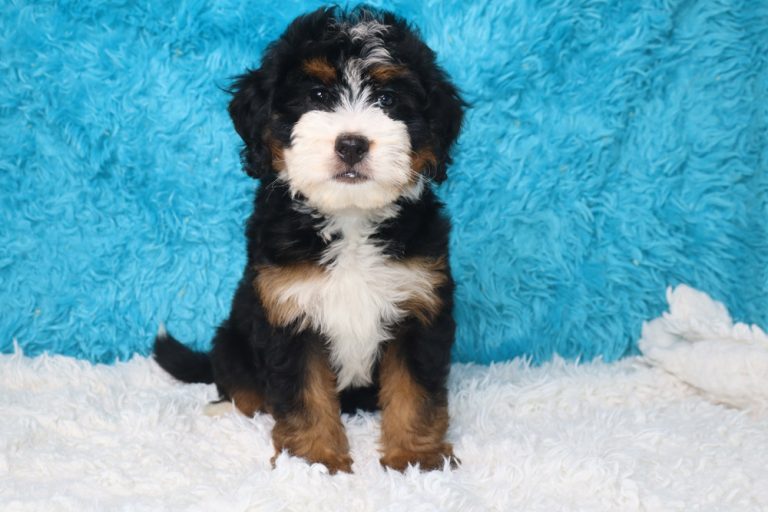
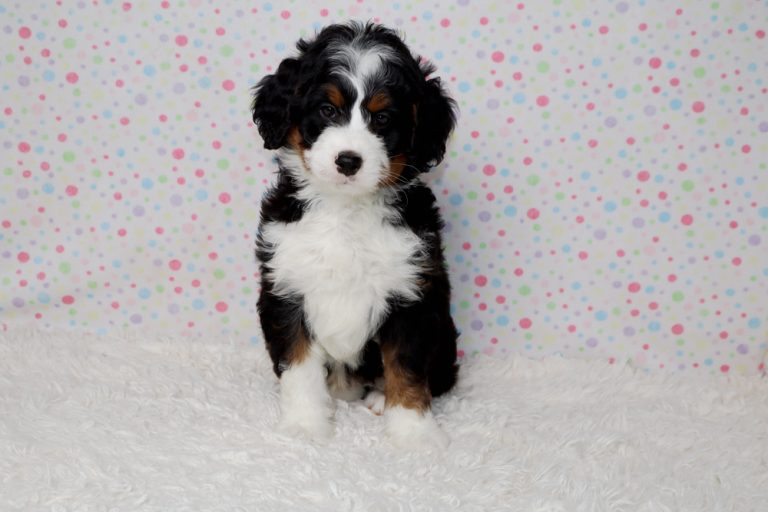
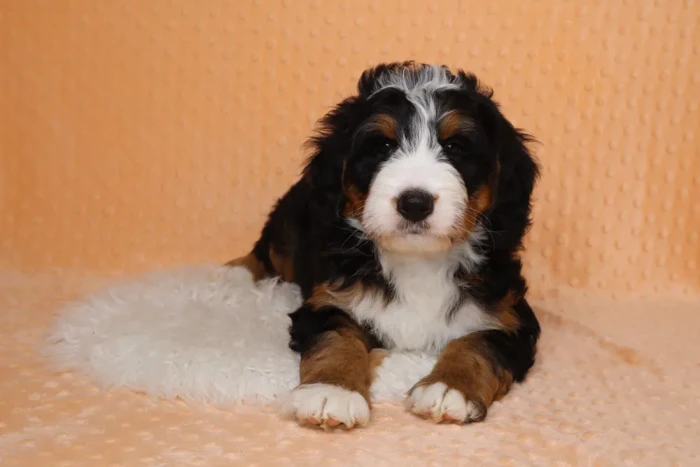
Mini Bernedoodle Puppies

Mini Bernedoodle Puppies for Sale

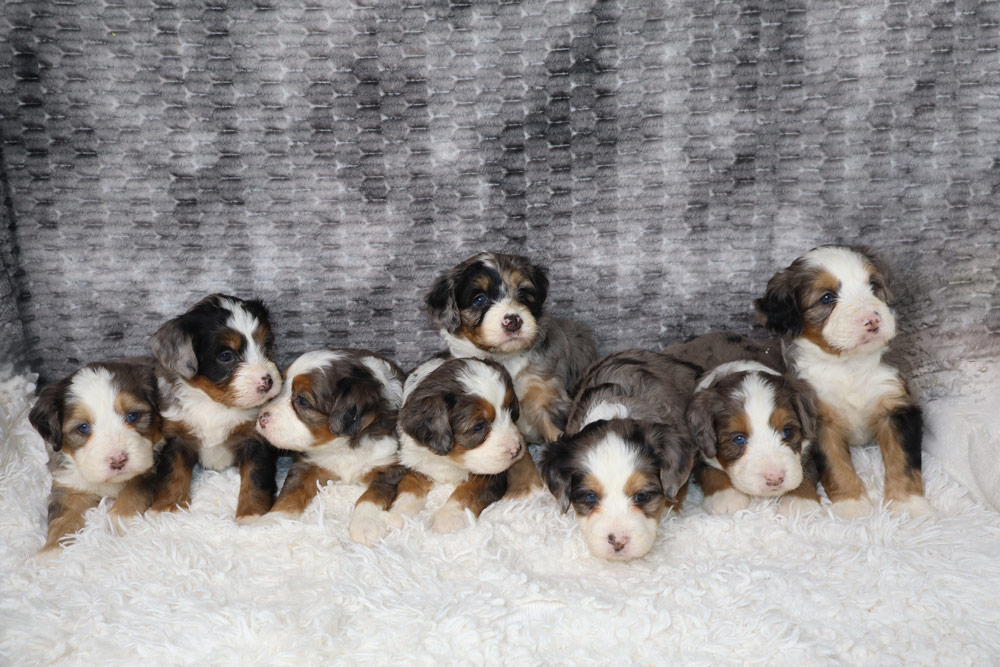
Mini Bernedoodle puppies combine the Bernese Mountain Dog’s loyalty and calm nature with the low-shedding coat and sharp intelligence of the Miniature or Toy Poodle. Adult Mini’s stand 18 to 22 inches tall and weigh between 35 and 55 pounds, big enough to keep up on a hike but small enough to actually fit your home and your day-to-day. These are dogs built for real family life. Blue Diamond breeds all Mini Bernedoodle litters as first-generation (F1) crosses, with both parents genetically tested, and every puppy is temperament-tested individually by an independent trainer before going home.

Mini Bernedoodle Puppy
Sign up for our Newsletter to get info on upcoming litters & other news from Blue Diamond Family Pups

Our Available Mini Bernedoodle Puppies!

We Have More Puppies Coming Soon!

Upcoming Litters!

5 Weeks Old

Breed: F1 Mini Bernedoodle

05/20/2026

Male Puppies: 1
Female Puppies: 3

$2995.00

4 Weeks Old

Breed: F1 Mini Bernedoodle

05/25/2026

Male Puppies: 6
Female Puppies: 2

$2995.00

6 Weeks Old

Breed: F1 Mini Bernedoodle

05/11/2026

Male Puppies: 8
Female Puppies: 2

$2995.00

Some Adopted mini Bernedoodle Puppies

Paisley

Female

Adopted
Breed: F1 Mini Bernedoodle

Bolt

Male

Adopted
Breed: F1b Mini Bernedoodle

Rumi

Female

Adopted
Breed: F1b Mini Bernedoodle

Pixie

Female

Adopted
Breed: F1b Mini Bernedoodle

Ingrid

Female

Adopted
Breed: F1b Mini Bernedoodle

Ryder

Male

Adopted
Breed: Mini Bernedoodle

What Is a Mini Bernedoodle?

A Mini Bernedoodle puppy is a crossbreed between a purebred Bernese Mountain Dog and a Miniature or Toy Poodle. The breed doesn’t carry the centuries of history that a working or show dog does, but its origins are well documented. Intentional breeding of this cross began around 2003 in Canada, when breeders set out to combine the Bernese Mountain Dog’s steady temperament with the Poodle’s low-shedding coat and sharp mind. Neither parent breed is an accident of selection. The Bernese Mountain Dog was developed in Switzerland as a drafting and herding dog, built for endurance and a calm disposition around families. Miniature Poodles trace back to Germany, where they were bred for water retrieval and recognized early on for their problem-solving ability and trainability. The Mini Bernedoodle inherits from both.

Mini Bernedoodles at a glance
Adult weight 35 to 55 lbs
Height at shoulder 18 to 22 inches
Lifespan 12 to 18 years
Generation at Blue Diamond F1 and F1B (Bernese Mountain Dog × Mini or Toy Poodle)
Shedding Minimal to none after first grooming appointment
Coat Wavy to curly
Hypoallergenic Yes, low dander

Mini Bernedoodle Full-Grown Size

Adult weight runs from 35 to 55 pounds, and they stand 18 to 22 inches at the shoulder. Size isn’t fixed. Males tend to land toward the upper end of both ranges, while females often finish between 25 and 40 pounds as adults. The best estimate for any individual puppy comes from knowing both parents, which is why asking for sire and dam weights before choosing a puppy matters more than most buyers realize.

F1 vs. F1b Mini Bernedoodles: What the Difference Means

All Blue Diamond Mini Bernedoodle litters are F1 generation. An F1 dog has one purebred Bernese Mountain Dog parent and one purebred Miniature or Toy Poodle parent, making it 50 percent of each breed. Coat types range from wavy to curly, depending on which parent a given pup takes after more strongly, which is why every pup gets tested individually. An F1b Mini Bernedoodle is bred differently. This is the pairing of an F1 Bernedoodle with a purebred Poodle, creating a cross that runs 75 percent Poodle and 25 percent Bernese Mountain Dog. F1b dogs carry curlier, lower-shedding coats because of the higher Poodle percentage. Both generations make great family companions, but buyers with moderate-to-severe dog allergies may want to focus on F1b litters.

Mini Bernedoodle Temperament

Mini Bernedoodle Puppy

Mini Bernedoodles aren’t aggressive. The Mini Bernadoodle is calm with strangers once introduced. This breed is patient with children of all ages and adaptable to households with other dogs and cats. What comes through most consistently across litters is loyalty. These dogs want to be near their people, and they’re not shy about showing it. Long periods alone don’t suit them, which is worth considering before bringing one home if your household is empty for eight or more hours on a regular workday.

Training a Mini Bernedoodle

Both parent breeds rank among the most trainable dogs in the world, and Mini Bernedoodles carry that same skill. Puppies pick up commands faster, identify new behaviors with fewer repetitions than most breeds, and want to cooperate. Positive reinforcement works best with this breed. Harsh corrections tend to shut them down rather than correct the behavior. Starting socialization early, while puppies are still between eight and sixteen weeks old, sets the foundation for how the dog handles new environments, sounds, and people for the rest of its life. The one area that needs attention early is separation. Puppies that never practice being alone tend to develop anxiety as adults, and working on short alone-time sessions from the first week in the home prevents most of that.

Growth & weight chart
Age Estimated weight range
8 weeks (go-home age) 4 to 8 lbs
3 months 11 to 18 lbs
6 months 25 to 38 lbs
9 months 30 to 48 lbs
Full grown (12 to 14 months) 35 to 55 lbs

Grooming a Mini Bernedoodle

Mini Bernedoodles have a wavy to curly coat that doesn’t shed much, but won’t stop growing. Grooming is non-negotiable. Grooming your Mini every 12 to 16 weeks keeps the length manageable. It’s necessary to prevent matting before it becomes a real problem. Between appointments, brushing at least twice a week is what actually keeps things healthy day to day. In the first year, puppies shed their softer puppy coat and grow into the adult coat, which tends to be denser and more prone to tangling during that transition. Brushing frequency should increase during those months, not decrease.

Exercise and Daily Activity

Thirty to sixty minutes of daily activity keeps a Mini Bernedoodle healthy and out of trouble. Walks are enough on most days. They’ll take a hike, a swim, or a long game of fetch without complaint, which makes them a good fit for active families as well as those with a calmer daily routine. Puppies under one year should avoid high-impact activity like jogging or jumping from heights until their joints have fully developed. After the first birthday, higher-impact exercise like running, agility, and long hikes becomes fair game.

How We Raise Our Mini Bernedoodle Puppies

Blue Diamond puppies don’t go through a standard whelping-box-to-go-home process. What happens between birth and 8 weeks is what makes the difference in how a puppy transitions into a family home.

Early Neurological Stimulation (ENS)

ENS starts at day 3 and runs through day 16. During this window, each puppy receives five specific handling exercises once per day: tactile stimulation, thermal stimulation, head-up positioning, head-down positioning, and supine positioning. The research behind ENS, originally developed for military working dogs, shows that mild stimulation during the neurological development window produces dogs with stronger cardiovascular systems, improved stress tolerance, and greater adaptability to new environments.

Kimberly’s Temperament Evaluation

Kimberly, Blue Diamond’s independent puppy trainer, evaluates every puppy at 7 weeks. She assesses each dog individually across multiple temperament dimensions, writes a full personality description, and scores traits that help match each puppy to the right family. That report goes live on the website alongside the puppy’s listing. Families don’t get a generic breed description. They get a profile of the specific dog they’re considering.

Socialization Before Go-Home

Between ENS and Kimberly’s evaluation, each puppy spends weeks being handled by multiple people, exposed to household sounds, moved through different environments, and socialized with other dogs. By go-home day, these aren’t puppies that have only ever seen the inside of one room.

Mini Bernedoodle Health and Lifespan

The Mini Bernedoodle has an extended lifespan of roughly 12 to 18 years with proper care. This exceeds the Standard Bernedoodle’s lifespan, because smaller dogs put less wear on their bodies as they age. The most typical health concerns in the breed include hip and elbow dysplasia.  Also common are certain eye conditions that are inherited from the Bernese Mountain Dog side. None of these are inevitable. Genetic testing of both parents before breeding catches the majority of preventable conditions before they reach a litter, which is why Blue Diamond tests sire and dam on every pairing. Routine vet visits, good flea and tick prevention, and quality food fill in the rest.

Are Mini Bernedoodles Hypoallergenic?

No dog is fully hypoallergenic. That’s worth saying because many breeders overstate it. Mini Bernedoodles produce less dander than most breeds, and their low-shedding coats mean less airborne hair carrying allergens through a home. F1b puppies tend to be lower-shedding than F1 puppies because of the higher Poodle percentage. If your allergies are mild to moderate, a Mini Bernedoodle is usually worth a try. Anyone with severe dog allergies should spend time with the specific puppy before committing, because that’s the only way to know for certain.

Mini Bernedoodle Coat Colors and Coat Types

Mini Bernedoodle coats range from wavy to curly depending on which parent a given puppy takes after, and that variation shows up differently from one dog to the next. The wavier ones pull more from the Bernese side. Curly coats lean toward the Poodle side. Shedding is minimal either way. After the puppy coat comes out around the six-month mark, it drops further still.

Blue Merle.

The marbling in a Blue Merle coat comes from grey, black, and white mixing across the fur in patches that don’t follow a predictable pattern. Eye color is part of the merle expression too. One eye may be brown while the other is blue, or both can go either way.

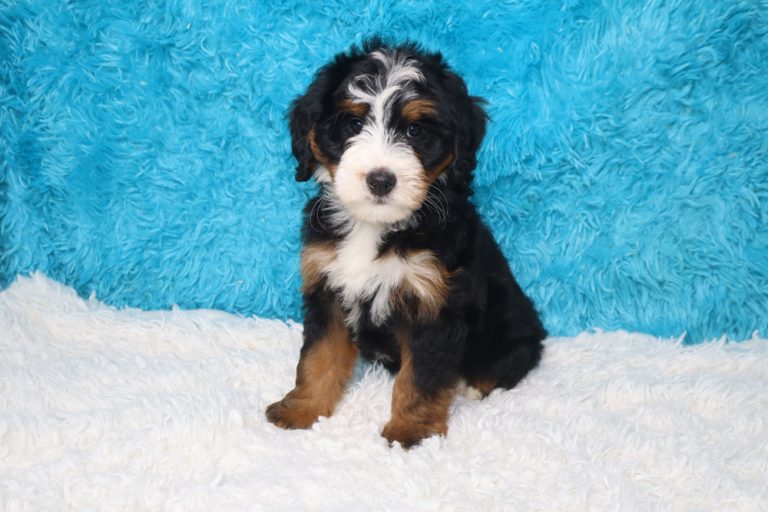
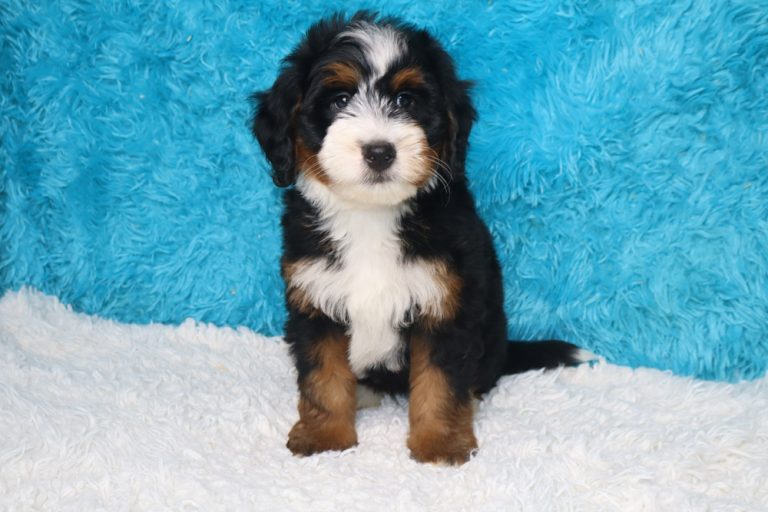
Tri-color.

Black, white, and rust. Those are the same three colors that define the Bernese Mountain Dog parent, and it’s the pattern buyers ask about most. F1 litters express this combination more consistently than later generations, which is part of why many families specifically seek out F1 puppies.

Black and white.

Black and white drops the rust and keeps a bold two-tone contrast that reads cleanly from a distance. It’s sometimes called bi-color. Families who want the striking pattern of the Bernese Mountain Dog without the three-color complexity, or who simply prefer a cleaner look, tend to land here.

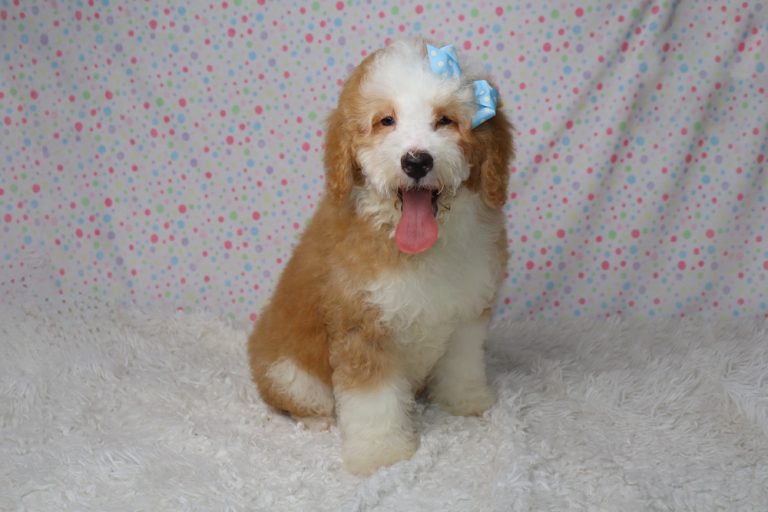
Sable

Sable puppies arrive looking much darker than they’ll end up. The color shifts through the first year as the adult coat grows in. This results in puppies with warm brown tips over a lighter base.

Phantom

Phantom markings have a distinct point pattern, featuring a darker base coat with a second color showing above the eyes, on the muzzle, chest, and legs. The placement is similar to the classic two-tone look seen in Dobermans, just in a Bernedoodle’s colors.

Each puppy’s coat color is confirmed by Kimberly at the 7-week temperament evaluation. That information is included in the individual listing when it goes live. Every Mini Bernedoodle needs a full groom every 12 to 16 weeks to stay mat-free. That’s non-negotiable. Brushing between appointments, a few minutes a few times per week, makes each grooming appointment easier on both the dog and the groomer.

How to Get a Blue Diamond Mini Bernedoodle

Step 1: Browse available litters or join the newsletter.

Available puppies post on this page as soon as Kimberly completes temperament testing at 7 weeks. Sign up for the newsletter to get notified the moment a new litter goes live. Litters fill quickly.

Step 2: Reserve your puppy.

Puppies with a price listed are available now. Clicking ‘Details’ on any listing opens Kimberly’s full temperament profile, covering the puppy’s energy level, how it responds to new people and other dogs, and what training approach she recommends for that specific animal. Reserving a puppy requires a deposit. Klarna is available at checkout for families who want to split the purchase over time, credit card payments are preferred for deposits and cash or card payments are preferred for full payments..

Step 3: Bring your puppy home.

Puppies go home at 8 weeks. Blue Diamond connects families outside driving range with vetted transporters who handle the logistics. Your puppy leaves with a health certificate, full vaccination record, deworming documentation, Kimberly’s written temperament profile, and any relevant parent health testing paperwork that applies to that litter.

Can Mini Bernedoodles Be Registered?

The American Kennel Club does not recognize Mini Bernedoodles or any other mixed breed, which means AKC registration isn’t an option regardless of how established the breeding program is. Two clubs do. The Designer Dogs Kennel Club (DDKC) and the American Canine Hybrid Club (ACHC) both register this cross and can provide documentation of the puppy’s parents. Registration doesn’t change the dog, but it creates a lineage record that matters to some buyers.

Is a Mini Bernedoodle the Right Dog for You?

A Mini Bernedoodle fits into many different living situations. Apartments, smaller homes, and houses with yards all work well for this breed as long as the exercise routine stays consistent. They’re not a good match for households where the dog will be alone for ten or more hours on a regular basis. Commitment matters. These dogs do best with a person or family that’s home a reasonable amount of the time, can follow the grooming schedule, and wants a dog that’ll be close by more often than not. If that sounds like your household, it’s hard to find a better fit in this size range.

Mini Bernedoodle Care Guide

Exercise

Adult Mini Bernedoodles do well with 30 to 45 minutes of exercise daily. That can be split across two shorter walks plus some backyard play rather than one long session. Mini Bernedoodles are a lower-energy cross than their Standard counterparts, and the smaller frame means they tire out faster on walks but also recover faster. Puppies need far less structured exercise. A common guideline is 5 minutes of leash walking per month of age, twice per day, to protect developing joints while they’re still growing. Structured running and repetitive high-impact exercise should wait until the dog is at least 12 months old, since Minis finish growing earlier than Standards.

Grooming

Mini Bernedoodle coats require brushing two to three times per week at a minimum to prevent matting, and daily brushing between grooming appointments will keep the coat from developing the dense, tight tangles that force a groomer to shave the dog down rather than trim it. Daily brushing is better. A slicker brush and a metal comb are the two tools that do the most work. Grooming on a 12 to 16 week schedule keeps the coat at a manageable length. After the first grooming cut at around 6 months, shedding drops to minimal, which is a big part of why Minis are considered hypoallergenic. Introduce brushing during the first week at home, because puppies that learn early tolerate grooming far better as adults.

Feeding

Mini Bernedoodles should eat a food formulated for small to medium-breed puppies until around 10 to 12 months of age, then transition to an adult formula for the same size category. Unlike Standards, Minis don’t need large-breed puppy food in most cases, though Minis trending toward the upper end of the weight range (45 to 55 pounds) can benefit from it. Two meals per day is the recommended feeding schedule. A 35-pound adult Mini Bernedoodle eats approximately 1.5 to 2 cups of dry food daily depending on the formula’s caloric density, and dogs closer to 55 pounds will land at 2.5 cups or slightly more. Minis can gain weight quickly if overfed, so measure rather than free-feed.

Training

Mini Bernedoodles respond well to short, positive training sessions starting the first day at home. Short beats long at this age. Ten to fifteen minute sessions twice per day beat long sporadic sessions, and the Poodle intelligence in the cross means they pick things up fast while also getting bored fast if you repeat the same drill over and over. Keeping sessions varied holds their attention better than hammering the same command repeatedly. Minis also tend to be a little more sensitive than Standards, so a light touch with corrections and heavy use of praise and treats gets better results than any firm-handed approach.

What Mini Bernedoodle Families Are Saying

Mini Bernedoodle FAQs

Q:How big does a Mini Bernedoodle get?

A:A full-grown Mini Bernedoodle stands 18 to 22 inches tall at the shoulder and weighs between 35 and 55 pounds. Males run toward the upper end of that range, while females stay smaller on average.

Q:How long do Mini Bernedoodles live?

A:Mini Bernedoodle crossbreed can live between 12 and 18 years with proper care. The smaller body size compared to a Standard Bernedoodle contributes to that longer range.

Q:Are Mini Bernedoodles good with kids?

A:Yes. Mini Bernedoodles are patient and calm around young children, handling the energy and unpredictability of busy households without becoming reactive or anxious. Early socialization during puppyhood strengthens that foundation as the dog matures.

Q:Do Mini Bernedoodles shed a lot?

A:Shedding is minimal, especially in curlier F1b puppies. Low shedding doesn't mean low maintenance, though. The coat grows continuously and needs brushing two to three times per week and a groom on a 12 to 16 week schedule to stay mat-free.

Q:What is the difference between F1 and F1b Mini Bernedoodles?

A:An F1 puppy is 50 percent Bernese Mountain Dog and 50 percent Poodle, with one purebred parent of each breed and the most direct expression of both bloodlines. F1b dogs come from pairing an F1 Bernedoodle with a purebred Poodle, shifting the genetics to 75 percent Poodle and 25 percent Bernese Mountain Dog. Coats run curlier and shedding drops in F1b dogs. F1 litters produce more color and texture variety from puppy to puppy.

Q:How much exercise does a Mini Bernedoodle need?

A:Between 30 and 60 minutes of daily activity covers it for most dogs. A combination of walks and active play works well. These dogs enjoy longer outings and more varied exercise when offered, but they won't suffer on a quieter day when the schedule only allows a walk around the block.

Q:Can Mini Bernedoodles be registered?

A:Yes, through designer breed registries. The Designer Dogs Kennel Club (DDKC) and the American Canine Hybrid Club (ACHC) both register this cross and can provide lineage documentation for the puppy and its parents. Mixed breeds are not recognized by the American Kennel Club regardless of how long the cross has been established.

Q:Are Mini Bernedoodles good apartment dogs?

A:Yes, as long as they get out every day. Their size, low-shedding coat, and calm indoor energy make them one of the more natural fits for apartment or condo life. A 30-minute walk each day is usually enough to keep them settled indoors.

Q:Do Mini Bernedoodles make good therapy dogs?

A:Yes. They have a gentle nature, intelligence, and an easy-to-train nature, making them well-suited for structured work with people in need. Many Mini Bernedoodles have been certified as therapy dogs, and their smaller size compared to a Standard Bernedoodle makes them easier to manage in clinical or facility settings.

Q:What is Early Neurological Stimulation (ENS)?

A:ENS runs from day 3 to day 16 of a puppy's life. There are five handling exercises that are completed once per day, timed to the developmental period when neurological stimulation produces the most lasting benefit. Dogs raised with ENS show measurable advantages in cardiovascular health, stress response, and learning speed over dogs that didn't receive it. Blue Diamond applies this protocol to every litter.

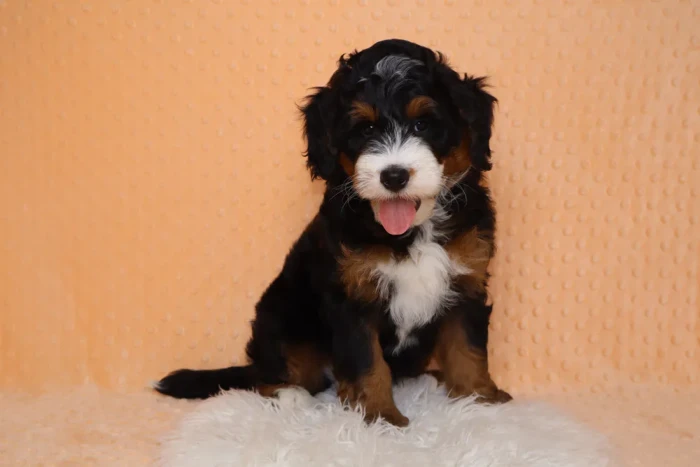
Ready to Bring Home a Mini Bernedoodle?

Browse the litters posted above or sign up for the newsletter to get notified the moment new puppies become available. Blue Diamond Mini Bernedoodle litters fill quickly once Kimberly’s temperament reports go live.

Reach Blue Diamond through the contact page with any questions before reserving.

News Letter Signup

* indicates required
Blue Diamond Family Pups News Letter