
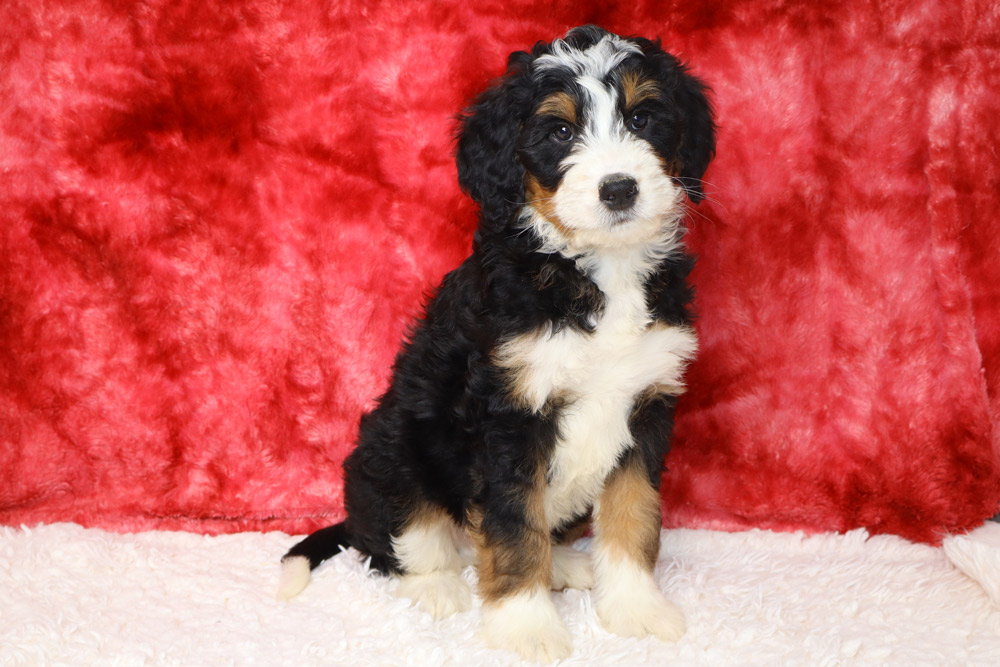
The labeling of either F1 or F1b on a Bernedoodle listing is about the single-most valuable piece of information a buyer can get from a breeder. A labeled Generation informs the buyer exactly what percentage of each of the two parent breeds contributes to the puppy. The Generation affects the overall coat texture and the amount of shedding; however, it also influences how much of the calm temperament of the Bernese Mountain Dog (the original selection criteria) is carried through to the adult dog.
Most buyers do not understand what these terms mean. This article provides an explanation for both types and assists in helping buyers determine which Generation would best suit their household needs.
First-Generation, or f1, refers to the first Generation of offspring resulting from the cross of a pure-bred Bernese Mountain Dog female with a pure-bred standard Poodle male. Therefore, the puppies produced by such a mating would be half (50%) Bernese Mountain Dog and half (50%) standard Poodle. Each of the two breeds contributes equally to characteristics such as coat type, energy level, and temperament. Characteristics of the calm, steady disposition of the Bernese Mountain Dog make the bernedoodle one of the most popular family pets in the United States.
When we say F1b, we are talking about taking an additional step. When a breeder uses an F1 bernedoodle mother with a standard Poodle father, the result is known as an F1b bernedoodle. Essentially, we are creating a back-cross. In doing so, we are increasing the number of Poodle genes contributed to the bernedoodle puppy. As a result, an F1b bernedoodle would have approximately 75% Poodle DNA and 25% Bernese Mountain Dog DNA. The increased presence of Poodle DNA creates a tighter, curlier coat. Less allergenic material is released during shedding. The overall energy and alertness levels increase due to the Poodle’s influence, potentially leading to a stronger sense of alertness.
F1 Bernedoodles produce a Wavy to loosely curly coat that exhibits minimal shedding. Typically, once the puppy coat falls off at around 5-6 months old, there is almost no shedding. Most families who experience mild pet allergies do just fine with both generations. F1b bernedoodles produce a tight curl coat that exhibits virtually no shedding. A higher percentage of Poodle DNA results in a coat that captures shed hair rather than allowing it to fall onto furniture or clothing.
F1 Bernedoodles require brushing approximately 2-3 times weekly. Grooming appointments occur every 10-14 weeks. The frequency and duration of these appointments increase with time. F1b bernedoodles require brushing nearly daily. Grooming appointments occur every 6-8 weeks. Due to the coat’s tightly curled nature, matting occurs quickly. Matting causes dense packing, requiring longer, more laborious Grooming sessions when missed schedules become apparent over time.
| Genetics | 50% Bernese / 50% Poodle | 25% Bernese / 75% Poodle |
| Coat Texture | Wavy to loosely curly | Curly |
| Shedding | Minimal | Minimal to none |
| Allergen Level | Low | Very low |
| Energy Level | Moderate, settled | Moderate to slightly higher |
| Grooming Schedule | Every 10 to 14 weeks | Every 6 to 8 weeks |
| Home Brushing | 2 to 3 times per week | Daily or near-daily |
While differences in coat textures are evident during Grooming sessions, temperament differences will manifest themselves in your dog’s behavior every single day. A major contributor to temperament is genetic influence. An F1 Standard Bernedoodle inherits 50% of its personality from the Bernese Mountain Dog. For hundreds of years, farmers chose Bernese Mountain Dogs specifically for their ability to work quietly and calmly among their livestock, free from excessive energy or anxiety. Those temperamental traits are what make them great companions for many families today.
An F1b Standard Bernedoodle inherits more of the sharp alertness and high-energy, quick beat associated with the Poodle. While this is not necessarily a negative trait for any particular family, it is a noticeable change from the calmer demeanor of an F1 Bernedoodle. Families transitioning from owning an F1 Bernedoodle may immediately notice this energy difference upon bringing their new pup Home. Regardless of Generation, neither is perfect for every family — but they are distinct enough that understanding those differences prior to reserving a puppy is essential.
As mentioned previously, if you want the maximum possible expression of the calm temperament found in Bernese Mountain Dogs in a Moderate-sized package with a relatively low-shedding coat, then choose the F1 generation. This is what attracted you to the breed in the first place. At Blue Diamond Family Puppies, we breed F1 Standard Bernedoodles for this exact purpose.
On the other hand, if you have serious allergies and/or have children with severe allergic reactions to dogs or suffer from asthma or documented allergies, then you should consider purchasing an F1b standard bernedoodle. While the benefits are undeniable, including a lower Allergen-load coat, there are drawbacks. Primarily, while less effort is required for Grooming compared to some breeds, regular brushings and more-frequent Grooming appointments are required than with an f1 standard bernedoodle.
At Blue Diamond Family Puppies, we primarily breed only first-Generation standard bernedoodles because our customers repeatedly express the same preference: they desire the calming temperament associated with the Bernese Mountain Dog in a smaller package with low-shedding qualities. The addition of Poodle genetics allows us to achieve this desired outcome. F1B variation ends up having more poodle than Bernese. While they are more hypoallergenic, you lose some the Bernese laid back temperament.
Both parent dogs at Blue Diamond are pre-breed genetically tested before being bred together. Each puppy undergoes early neurological stimulation (ENS) beginning on day 3 and receives Kimberly’s individualized written temperament evaluation prior to going on our website. Regardless of Generation, this process remains constant. However, the genetic makeup for coat and energy levels varies greatly depending on the Generation chosen.
For those undecided between generations, viewing available puppies at Blue Diamond lets you see Kimberly’s individualized written temperament profiles for each dog. Given that listings sell rapidly, it is advisable to review as many potential candidates as soon as possible. Both parents were genetically tested prior to breeding. Each puppy underwent ENS starting on day 3. And finally, visit our breed page to see pictures and read details regarding health testing conducted on each litter’s sire and dam, along with growth charts detailing our standard Bernedoodles’ expected sizes.
Browse available standard bernedoodle puppies for sale now. Sign up for our newsletter to be notified whenever new litters post!