
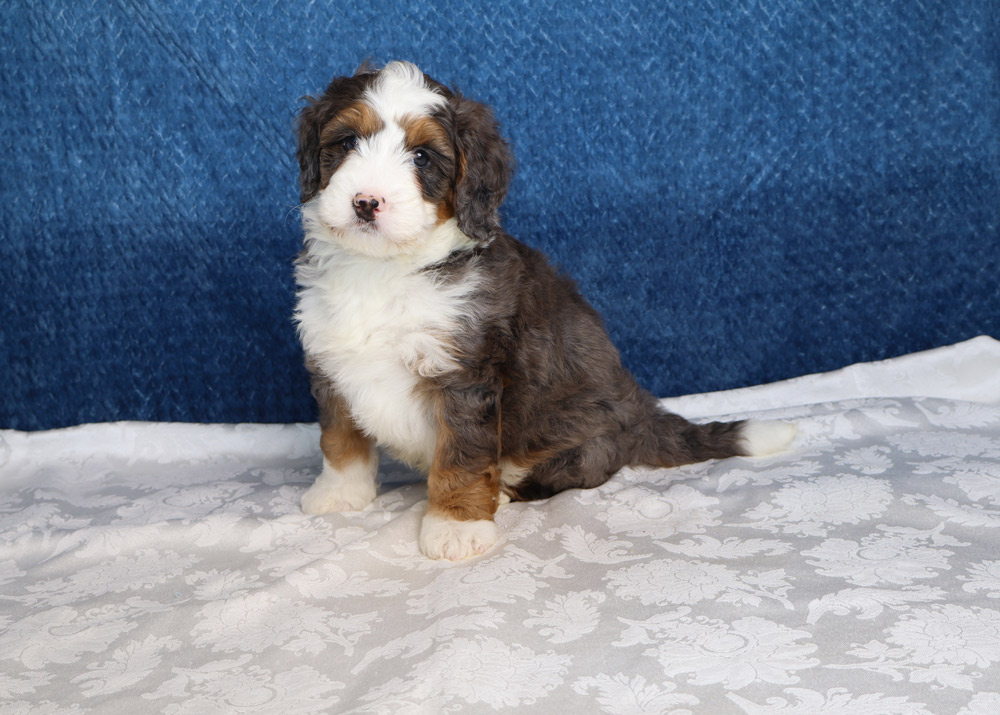
A Mini Bernedoodle full-grown runs approximately 35 to 45 pounds in most cases, but pinning down a more specific number takes more than a breed chart alone. You need to know what size crate to order, whether it fits in your car, and whether your living space works before the puppy arrives. Size is the question we hear more than almost any other at Blue Diamond Family Pups. It makes sense. Understanding what actually drives the range puts you in a much better position when you start shopping for a puppy.
We’ve placed Mini Bernedoodles with families all across the country and we know the weight history of every dam and sire we work with. Parent weights matter here. That lets us give a tighter size estimate for any specific litter than a breed chart ever could, and we’re glad to have that conversation before you commit to anything.
Most dogs reach their full height well before they finish filling out in muscle and body mass. Mini Bernedoodles follow that same pattern, reaching their full frame somewhere between 12 and 14 months and then continuing to fill out for roughly another six months after that.
Height and final body weight move on different timelines, and mixing them up is where a lot of new owners get caught off guard. A Mini Bernedoodle at 12 months might look close to done but still have another five to eight pounds of filling out ahead. That’s normal.
Our F1 Mini Bernedoodles run approximately 35 to 55 pounds at full maturity, standing approximately 18 to 22 inches at the shoulder. Most of our litters land in the middle of that range, with males tending to finish toward the upper end and females landing toward the lower end. Those numbers come from what we’ve actually seen here. We found that a fairly accurate way to estimate your adult dog’s weight is to take the puppy’s weight at 8 weeks and multiply it by 4. A puppy at the outer edges of that range isn’t unusual, but the parents’ weights tell us far more about where a specific dog will land than any breed average chart could on its own.
F1B Mini Bernedoodles tend to run slightly smaller because they’re 75 percent Poodle. Size is still variable, though. We’ve seen our F1B puppies land somewhere between approximately 20 and 38 pounds in most cases, with females consistently coming in toward the lower end.
The best predictor of size we have is the parents’ weight. For example, if we pair a smaller Toy Poodle male with a medium sized Bernese female, the puppies will be at the lower end of the range. Or if we pair a heavier Miniature Poodle male with a larger Bernese Mountain Dog female, everything shifts upward. It’s that direct. When you’re looking at a specific puppy from us, we can tell you what the mom and dad weigh, and that single piece of information is worth more than any breed-average chart out there.
We always share parent weights with any family who’s looking at a specific litter. It’s the most useful number you’ll have when picturing what you’re actually bringing home.
Before any puppy goes home, we give families a size estimate based on what the mom and dad actually weigh. It’s not a guarantee, but it’s a real number, not a range pulled from a breed website. That conversation happens before you decide.
Generation plays a role in size, but a smaller one than most people expect. The difference is real. F1B puppies tend to run slightly smaller on average, but we’ve placed F1B puppies from our litters that grew larger than some F1 puppies from the same season, which shows how much parent weight matters in the end.
Males consistently run larger than females in our Mini Bernedoodle litters, and the gap is real enough to factor into your planning. A male from one of our F1 litters tends to finish somewhere between approximately 35 and 45 pounds as an adult. Females from the same litter often come in closer to approximately 28 to 38 pounds. That’s the gap.
Neither sex is a better dog. The decision usually comes down to what feels right for your household, and we’ve seen great dogs regardless of which sex a family chooses.
Most Mini Bernedoodle puppies leave for their new homes at approximately eight weeks old and weigh an estimated 8 to 12 pounds at that point. Growth moves fast from there. By three months, most have reached 15 to 22 pounds as their frames begin to extend and the roundness of puppyhood starts to stretch out. The most noticeable growth span runs roughly from three to seven months, and it’s the stretch that surprises most new owners. Past that point, the pace slows noticeably, and by twelve months your dog will look pretty much like the adult they’re going to be, even if the last few pounds are still filling in.
After about 14 months, the weight you see on the scale is close to the weight you’ll have for most of your dog’s long life. Some dogs add a couple of pounds of muscle definition through age two, but the frame is set. That’s when most owners stop worrying about it.
We also breed Micro Bernedoodles and Standard Bernedoodles here at Blue Diamond, so we can speak to all three from experience. A Micro finishes smaller. Micro Bernedoodles from our program run approximately 15 to 25 pounds at full maturity, which makes them noticeably smaller in person. Standard Bernedoodles can reach approximately 60 to 90 pounds as adults, which is a real jump up from a Mini in terms of space, food, and grooming time.
Most families choosing between Mini and Micro are really making a practical space decision. A Micro is a genuinely smaller dog in daily life, and the difference shows up in things like lap space, vehicle fit, and how much food you’re buying each month.
For a full-grown Mini Bernedoodle at roughly 35 pounds, a 36-inch crate works well. Size up for males. Most families we work with end up with either a 36 or 42-inch crate depending on where their specific dog landed in the range, and buying for the adult size at go-home saves you from buying a second crate six months later.
In terms of vehicle fit, a Mini Bernedoodle in the approximately 30 to 40 pound range handles most back-seat setups without a problem. A standard SUV cargo area fits a crate comfortably. Smaller sedans can work if you have a dog toward the lighter end. If you drive a compact car and you’re expecting a male from a heavier pairing, it’s worth thinking through the setup before the puppy comes home.
For apartment living, a Mini Bernedoodle fits. They’re not so large that a smaller space feels cramped, and there’s nothing fragile about them. Daily exercise matters most with this breed, and a solid walk each day does more for a Mini Bernedoodle than an extra room ever could.
No breeder can guarantee you an exact adult weight, and anyone who tells you they can isn’t being honest with you. What we can give you is a range based on the actual weights of the parents, which narrows things down far more than any breed-average chart can. Genetics still has the final say. Our best advice is to buy the bigger crate, plan for the higher end of the estimate, and enjoy watching your dog figure out who it’s going to be.
Every Mini Bernedoodle we’ve placed has been a little different, and that’s part of what makes this breed interesting to work with. When you’re ready to talk through a specific litter and want to know what we’d expect from that pairing, reach out and we’ll walk you through it.