
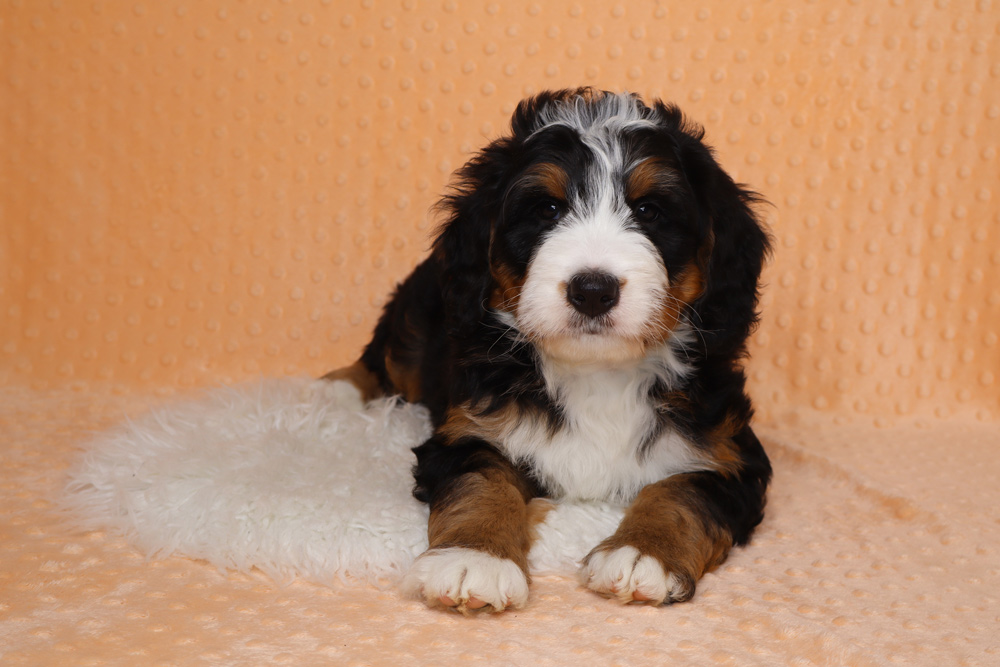
The Mini Bernedoodle vs Mini Goldendoodle decision trips up more buyers than almost any other choice in the Doodle world, and it’s easy to understand why. Both dogs are low-shedding and built for family life. Half of what either dog is comes from the Poodle. On paper they look nearly interchangeable. They’re not.
We raise both breeds here at Blue Diamond Family Pups, on the same farm, under the same care standards, so we’ve watched these dogs grow up side by side across dozens of litters. What follows is what we’ve actually seen, not a chart someone else made.
Both the Bernese Mountain Dogs and the Golden Retrievers are gentle, people-oriented breeds. Beneath the surface, they’re built differently, and those differences show up clearly in their Doodle offspring. The Bernese is calm, loyal, and almost stoic. It bonds deeply with its people, stays close to home, and doesn’t carry the kind of restless, go-go energy that Goldens naturally do.
The Golden Retriever runs on different fuel. It wants to be doing something with you at all times of the day. A Mini Goldendoodle picks up that energy and tends to run a little hotter day to day than a Mini Bernedoodle does. Neither is better than the other, but for a family that wants a dog to settle in at the end of a quiet evening, the Mini Bernedoodle usually wins. A more active household looking for a dog that can keep up with their pace and their kids will usually find the Goldendoodle fits better.
On our farm, we consistently see that Mini Bernedoodle puppies settle into a new home more quickly than Goldendoodle puppies do. Goldendoodle pups need more outlets early on. Mini Bernedoodle pups are often content to sit near you while you work, which is something many families with home offices tell us they didn’t expect to love as much as they do. That gap in resting energy is real.
Both breeds inherit a Poodle-influenced coat, so both are low-shedding and require regular grooming. The difference between the two is that the Mini Bernedoodle litters tend to produce more wavy, looser hair, while Mini Goldendoodles tend to run slightly curlier, though you’ll see real variation in both. Tighter curls mean more matting risk when brushing gets skipped. A wavier coat gives you a little more time between groomer visits. Over the years, that difference adds up in real daily effort.
You’ll need a groomer on a regular schedule with either of these dogs, roughly every six to eight weeks depending on coat type and how much you keep up at home between appointments. Neither breed is low-maintenance. That’s true whether you’re talking about a Mini Bernedoodle or a Mini Goldendoodle. These are details we can discuss with you.
On paper, the size ranges look similar. A full-grown Mini Bernedoodle runs approximately 35 to 55 pounds. Compared to a full-grown F1 Mini Goldendoodle, which runs approximately 20 to 45 pounds. In practice, across our own litters, the sizes overlap a great deal, and the difference from one pairing to the next often matters more than the breed label itself. If you want the smaller end of the range, the Mini Goldendoodle has a clear advantage, as we also breed F1BB Goldendoodles that weigh approximately 15 to 25 pounds at maturity.
There’s also a lifespan difference between the two breeds worth knowing about. Mini Bernedoodles live approximately 12 to 18 years. Compare this to approximately 12 to 16 years for Mini Goldendoodles, which means if you’re thinking about a 15-year companion, the Bernedoodle is the more likely candidate.
Both our Mini Bernedoodles and our Mini Goldendoodles undergo the same Early Neurological Stimulation protocol from day three to day 16, and Kimberly conducts an individual assessment on every puppy from both breeds. The starting point is the same. What sets them apart is what they were bred to be.
Both breeds are some of the easiest dogs to train in the Doodle world, and that’s not something we say about every breed we work with here on the farm. The Poodle genetics in both make them fast learners who want to please. The difference shows up in focus.
Mini Goldendoodles tend to be all-in from the first session, enthusiastic and eager to please right out of the gate. The Bernedoodle learns just as fast, but can be slightly more deliberate about it. They’ll study you before they fully commit. Once they trust the process and feel settled with you, they lock in and hold commands reliably.
Stick with positive reinforcement for either dog. Harsh corrections shut both breeds down faster than almost any other training mistake you can make.
Both breeds are low-shedding and easier on allergies than most, thanks to their Poodle side, which is a big reason families who’ve had trouble with other dogs end up here. Neither one is guaranteed safe for people with severe allergies. Individual puppies vary, parent coats matter, and we always recommend spending time with a specific puppy before committing if allergies are a real concern in your household.
If we had to call it, the Mini Goldendoodle edges ahead on shedding consistency because their coats tend to come out curlier. The Mini Bernedoodle’s wavy coat is still very low-shedding for most families, it just isn’t quite as consistent from litter to litter. For families with serious pet allergies, our F1BB Mini Goldendoodles go the farthest because they’re guaranteed no-shed and approximately 87 percent Poodle, while the F1B versions of either breed close the gap in a real way by pushing the mix to 75 percent Poodle. That’s worth knowing before you decide.
Mini Goldendoodles are better matches for households that want an active, enthusiastic dog who’s up for anything at any time of day. They bring energy to every room. Families with active kids, outdoor hobbyists, and people who spend most of their weekends on the go tend to find that the Goldendoodle fits their pace better.
The Bernedoodle suits a whole different kind of household. The Bernadoodle is calmer day-to-day, more inclined to follow you from room to room rather than initiate play every hour, and they tend to do better in apartments and smaller homes where a higher-energy dog would feel restless. Seniors, remote workers, families with younger children who need a gentler dog, and first-time owners who want a dog they can realistically keep up with, those are the people who tend to find their way to our Mini Bernedoodles. That doesn’t mean they’re sedentary.
Both dogs need daily exercise and both can develop behavioral issues if they’re under-stimulated for too long. The difference is that a Mini Bernedoodle is usually content with a good walk and some time with you, while a Mini Goldendoodle is often looking for what comes next.
Our Mini Bernedoodle puppies start at $2,995. Mini Goldendoodle pricing at Blue Diamond varies by generation, with F1BB puppies starting at $1,995, making the Goldendoodle the more affordable entry point for families watching the budget. Both puppies come with the same care behind them, including our ENS protocol, Kimberly’s individual write-up on every puppy, genetic testing on both parents, and a one-year health guarantee.
Across the industry, both breeds run from roughly $2,000 to $5,000. This depends on the breeder and the generation. Price alone tells you very little. Every dollar of that range is really about what the breeder does before that puppy goes home, not which breed name is on the listing. Genetic testing on both parents, a real socialization program, and a health guarantee that actually means something matter far more than which breed name is on the tag.
After years of raising both breeds here, you start to see the same patterns. Mini Goldendoodle buyers often come in looking for an outgoing, playful dog with that Golden Retriever personality in a smaller body, and they’re almost never disappointed. Bernedoodle families frequently call us after they’ve settled in and say that loyalty was the part that surprised them the most, even more than the puppy’s temperament or the look.
The breed that surprises people most, in our experience, is our Mini Bernedoodle breed in households where someone works from home. Most owners don’t expect it. These dogs become genuinely attached companions, and they’ll follow you around and want to be near you in a way that feels less like a pet and more like a co-worker who actually likes you. We’ve placed plenty of Goldendoodles in those same households, and they do well too, but the Bernedoodle’s quieter presence is something different.
Neither dog is a bad fit for a family. The question is really about what kind of energy your household has and which dog will feel like it belongs there.
Choosing between either breed doesn’t have to be complicated. Take into consideration your average day. If it involves a lot of running around, outdoor activity, and kids who want to play constantly, the Mini Goldendoodle fits that pace naturally. Quieter days, or working from home, and an evening walk routine point toward the Mini Bernedoodle almost every time.
We’ve placed both breeds with families of every kind, including people who were dead set on one and ended up going home with the other after a conversation here on the farm. Both are genuinely good dogs. We’d rather you take an extra twenty minutes talking it through with us than rush into a choice that doesn’t fit your household.
If you’re still on the fence between a Mini Bernedoodle and a Mini Goldendoodle, reach out before you look at available puppies. We know both breeds well enough to ask you the right questions, and we’d rather match you with the right dog than sell you the wrong one.