
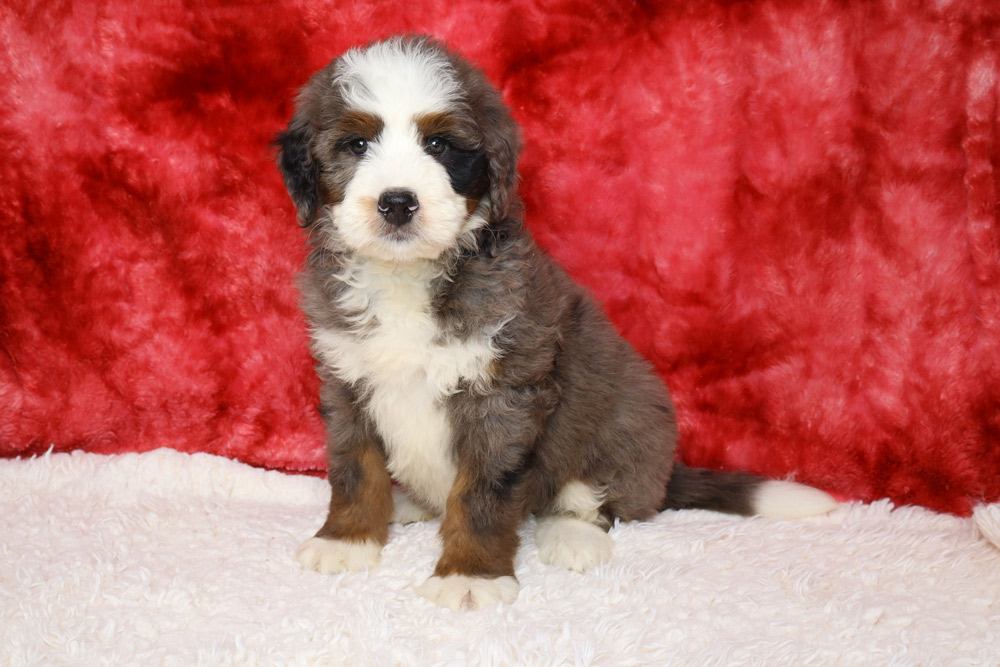
The most common question from families comparing Bernedoodles at Blue Diamond comes down to a core decision: how do the Mini and the Standard differ, and which one fits their household better? Both sizes come from the same Bernese Mountain Dog moms. The difference between them comes down to the Poodle dad’s size, which produces a measurably different adult dog in weight, exercise needs, and daily management. This article covers both sizes honestly so you can make a straightforward decision.
At Blue Diamond, Mini Bernedoodles can weigh up to 25 to 55 pounds as adults. Adults can stand anywhere from 18 to 22 inches at the shoulder. Standard Bernedoodles weigh 60 to 90 pounds and stand 23 to 27 inches, with males pushing toward the top of that range at full maturity. The ranges overlap at the edges. A large Mini and a small Standard Poodle pairing that are lighter in weight can end up with adult weights that are similar, which is one reason Blue Diamond recommends asking about specific parent sizes before reserving any puppy.
| Adult weight | 25 to 55 lbs | 60 to 90 lbs |
| Height at shoulder | 18 to 22 inches | 23 to 27 inches |
| Generation at BD | F1 | F1 |
| Bernese Mountain Dog mom | Same line at Blue Diamond | Same line at Blue Diamond |
| Daily exercise | 30 to 45 minutes | 45 to 60 minutes |
| Grooming schedule | Every 8 to 12 weeks | Every 8 to 12 weeks |
| Home brushing | 2 to 3 times per week | 2 to 3 times per week |
| Lifespan | 12 to 18 years | 10 to 15 years |
Both sizes share the same Bernese Mountain Dog moms at Blue Diamond, which matters considerably more than most buyers realize when they start comparing sizes. The Bernese foundation is the same. That calm, loyal, people-oriented temperament that draws most families to the Bernedoodle flows from the Bernese Mountain Dog side of the cross, and that side doesn’t change between sizes. What changes is the Poodle dad’s size, and that produces the weight difference, not a fundamental shift in how the dog relates to its family.
Mini and Standard Bernedoodles share a similar energy profile. Though the Standard needs slightly more daily movement to stay settled indoors. Minis do well with 30 to 45 minutes of daily exercise. Standards need 45 to 60 minutes. For most households, that difference doesn’t drive the size decision on its own, since both land within the range any family walking regularly would cover without much thought.
Grooming schedules for Mini and Standard Bernedoodles are nearly identical, as both are F1 crosses with wavy to curly coats that require brushing 2 to 3 times per week and a professional appointment every 8 to 12 weeks. Where they diverge is cost. Groomers charge by size, and a Standard Bernedoodle visiting a groomer will run noticeably more per session than a Mini does, a difference that adds up over the course of a year.
For families with suburban homes and yard access, either size fits naturally. Size becomes more relevant in shared living situations. For instance, buildings with pet weight limits, smaller vehicles, and households where managing a 90-pound dog is a genuine daily physical consideration. Knowing your specific situation before choosing a size saves the conversation nobody wants to have after the puppy is already home.
A Standard Bernedoodle in an apartment isn’t a mismatch if the owner provides enough daily exercise. That said, handling things like exercise, bathing, and getting around with a 70–90 pound dog in a city apartment is very different than doing the same with a 35-pound Mini. Outdoor access matters more than square footage.
For buyers in apartment living or smaller homes, the Mini is often the better choice. This is especially true for families with weight limits who want a dog that’s easier to handle every day. It’s also a natural choice for families with younger children who might not be able to handle the pull of a 90-pound dog. Also, for households where a smaller dog makes daily management more practical.
The Standard Bernedoodle is a better fit for families who like to stay active. Active dog owners like the Standard because they can keep pace with hiking, trail runs, and longer outdoor sessions. Large families often lean toward the Standard as well. Families who have owned large dogs before, have accessible outdoor space, and drive vehicles that accommodate a 70 to 90 pound dog find the Standard a natural fit. It also gives families the fullest physical expression of the Bernese Mountain Dog, which comes through more completely at the larger size.
Blue Diamond breeds F1 Mini Bernedoodles and F1 Standard Bernedoodles from the same Bernese Mountain Dog line, which means families can compare both options knowing the genetic foundation and early development program are consistent across sizes. Both parent lines are health tested. Every puppy goes through Early Neurological Stimulation (ENS) starting on day 3 and receives Kimberly’s individual written temperament evaluation before the listing goes live, giving families documented behavioral data to work with rather than a general description of what Bernedoodles are like.
Both are popular breeds at Blue Diamond. Available puppies are added to the website as soon as Kimberly completes temperament evaluations at 7 weeks for each litter. Litters post throughout the year. Sign up for the newsletter to be notified when either litter posts, since listings move fast once evaluations go live.Browse Standard Bernedoodle puppies for sale or Mini Bernedoodle puppies for sale. Both pages include Kimberly’s full written temperament profile for every available puppy.