
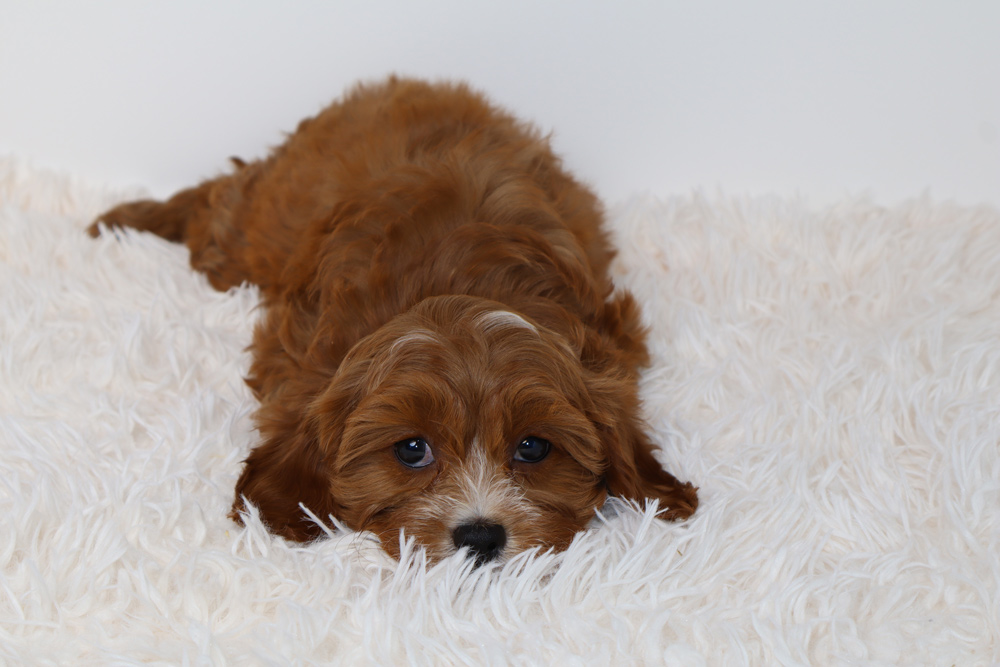
So you finally did it. You brought home a puppy. Your visit to our home to pick up your puppy went perfectly, or you had your puppy professionally delivered to you. Your new pup was all wagging tails and puppy kisses. You snapped 47 photos before you, or the driver, even left the driveway. Life is good.
Then you get home.
That confident little fluffball who charmed everyone at the breeder’s house is gone. In place is a terrified little puppy who won’t eat, won’t stop crying, and treats you like you’re out to get them. You’re texting your friend at 4 AM asking if puppies can die from sadness.
Welcome to the first 72 hours of puppy ownership.
Here at Blue Diamond Family Pups, we’ve handed over more puppies than we can count to families who have had that same experience. Different breeds, different sizes, different personalities. Doesn’t matter. Those first few days are a special kind of chaos for everyone involved. We get the panicked phone calls. We talk people down from the ledge. We’ve heard every worry, seen every meltdown, and helped hundreds of families push through to the other side, where everything actually gets good.
What you’re about to read is the truth about those first three days. Not the Instagram version where everything is perfect. The real version with crying at 3 AM and questioning all your life choices. Plus, we are going to talk about what actually helps you get through it, which has worked on hundreds of puppies across every breed we raise.
Let’s talk about what’s happening inside that fur baby’s little head.
Your puppy just went through the most traumatic experience of their short existence. Up until today, they knew exactly four things: their mom, their littermates, the place where they lived, and the people who loved and cared for them. That was their entire universe. Warm bodies to sleep against. Familiar smells everywhere. A routine they didn’t even know was a routine.
Then you fell in love with them, brought them home to spoil and love them forever. But this turns their whole world upside down for a little while because everything is new.
Sounds harsh, but that’s genuinely how it feels from their perspective. One minute, they’re playing with their siblings. Next minute, they’re in a car (terrifying), going to a completely alien environment where nothing smells right, nothing sounds right, and everyone they’ve ever known has vanished into thin air.
Different breeds handle this stress in different ways. Herding breeds might pace and whine because their instinct is to keep everyone together, and they can’t find their pack. Companion breeds might become velcro dogs immediately because attachment is their default setting. Independent breeds might hide under furniture and refuse to engage. Working breeds might channel anxiety into destructive behavior because they need an outlet for it.
But regardless of breed, all puppies experience a massive cortisol spike during this transition. Cortisol is your stress hormone. When it floods a puppy’s system, appetite disappears. Sleep gets disrupted even though they’re exhausted. Bladder control goes out the window. Everything that should be instinctive becomes harder because the brain is stuck in survival mode.
Here’s the part that matters, though.
Puppies are designed to adapt. It’s literally built into their neurology. That overwhelming stress response you’re seeing right now? It’s temporary. Most puppies start showing real improvement somewhere between day two and day five. The ones we raise here at Blue Diamond Family Pups tend to bounce back even faster because we put them through Early Neurological Stimulation starting at day three of life. ENS essentially trains their nervous system to handle stress better. You’ll see that training kick in during this rough patch.
Let me walk you through what you’re probably going to see over the next 72 hours. Some of this will shock you. Most of it is completely normal across every breed.
Number one panic call we get: puppy won’t eat. They sniff the food bowl, maybe take one bite, then walk away like you’re trying to poison them. Or they ignore it completely.
Stress kills appetite. Doesn’t matter if you’re feeding the exact same food they ate at our place. Everything tastes wrong right now because their brain is screaming danger signals. Some breeds are more food motivated than others, but even the chow hounds will sometimes refuse food during that initial transition.
What works? Ditch the bowl temporarily. Hand feed. Make it a game. Sit on the floor with them and offer individual pieces. Many times adding warm water to their food to soften it up and release the smell really helps. Mix in a tiny bit of wet food if you have it. Some puppies need you to pretend you’re eating it first before they’ll try it.
One family told us their Goldendoodle puppy (a breed famous for eating literally anything) wouldn’t touch food for 30 hours. They tried everything. Finally worked when the dad sat on the kitchen floor, put kibble in his own mouth, made exaggerated chewing motions, then offered the puppy a piece. Puppy ate the whole bowl. Sometimes you gotta get weird with it.
If your puppy hasn’t eaten in 24 hours, call your vet or us. If they’re refusing food AND showing other symptoms like vomiting or extreme lethargy, get them seen immediately. But nine times out of ten, appetite comes back once the stress hormones settle down.
You might be expecting a playful puppy. Instead, you got one that sleeps for five hours straight, barely twitches when you say their name, then crashes again an hour later.
Processing this much change is mentally and physically exhausting for puppies. Their brain is working overtime trying to map this new environment, figure out who these strange humans are, and cope with the loss of their littermates. That cognitive work drains them completely.
Larger breeds need even more sleep during growth spurts, and stress can trigger that need for extra rest. Smaller breeds have faster metabolisms, so they might seem more alert, but they still need way more sleep than you’d expect. We’re talking 18 to 20 hours a day for puppies this age.
Let them sleep. Don’t wake them up because you’re worried. Sleep is how their bodies reset and heal. What is the difference between healthy tired and sick lethargy? A healthy puppy wakes up responsive when you talk to them or offer food, even if they’re subdued. A lethargic puppy won’t wake properly or respond to normal stimuli. That’s when you need a vet.
The crying. Oh man, the crying. The whining. The howling. The sad little noises that sound like you’re torturing them. Some breeds are more vocal than others, but almost every puppy cries during those first few nights.
They’ve never slept alone. Not even once. They don’t understand where Mom went. They don’t know if their siblings are coming back. All they know is they’re alone in the dark, and it’s the scariest thing they’ve ever experienced.
This is exactly why we offer the Sibling Scented Heartbeat Puppy Pal to every Blue Diamond Family Pups customer. We take a stuffed toy with a built-in heartbeat and let it live with the litter for their last few days together. When your puppy gets home and smells that toy, they’re smelling their brothers and sisters. The heartbeat mimics sleeping in a puppy pile. It’s not a magic cure, but it helps tremendously.
Put that toy in their crate at bedtime. Keep the crate in your bedroom where they can smell you, not isolated down the hall. Cover the crate with a blanket to make it feel like a den. Run a white noise machine or fan. These things actually make a difference.
When they cry at night, check if they need to potty first. Puppies can’t hold it all night at this age. Take them out, keep it boring and dark, no playing or talking, then straight back to the crate. If they’re crying for attention and don’t need to pee, you can put your hand near the crate to reassure them, but don’t take them out unless you want that to become the permanent routine.
The first night can be brutal. The second night is maybe 40 percent better than the first night. By night four or five, most puppies are sleeping in longer stretches. The crying doesn’t last forever, even though it feels endless when you’re living through it.
Some puppies attach to one person immediately and follow them everywhere. Bathroom? They’re coming. Kitchen? Right on your heels. Trying to work? They’re under your desk. Companion breeds and herding breeds are especially prone to this because staying close to their person is literally what they were bred to do.
This is actually a good sign. They’ve decided you’re their safe person. Let them follow you during these first few days. They need that security. As they get more confident in the house and realize you’re not going anywhere, they’ll naturally start exploring independently. Forcing separation too early just cranks up the anxiety.
Other puppies go the opposite direction. They find a hiding spot (under the bed, behind furniture, in a closet) and refuse to budge. You can’t coax them out. Treats don’t work. They just want to be invisible.
More common in naturally cautious breeds or puppies with shyer temperaments. This is why we do professional temperament testing on every puppy before placement. This helps match personality types to families, specifically to avoid major mismatches. But even confident puppies can sometimes shut down temporarily when overwhelmed.
Don’t drag them out. Don’t hover. Set up food, water, and their Heartbeat Puppy Pal near the hiding spot. Sit in the same room and ignore them. Read. Watch TV. Exist peacefully nearby. Let them come investigate you when they’re ready. This approach works way better than trying to force interaction.
Issues
Stress messes with bladder control across all breeds. Also, their entire potty routine just changed. A different door to go outside. Different surface underfoot. Different smells. They have to learn your house from scratch, including where the bathroom is supposed to be.
Take them out constantly. Every hour when awake. Immediately after eating, drinking, playing, or waking up. Use the same door every single time. Go to the same spot in the yard. Use a command word like “go potty” and stick with it religiously. When they go outside, celebrate like they just won an Olympic medal.
For accidents inside, use enzyme cleaners. Regular cleaners just hide the smell from human noses. Dogs can still detect the urine markers that tell them “this is a bathroom.” Enzyme cleaners completely break down those chemical markers.
Accidents will drop dramatically by day four or five once they understand the new system. Stay consistent.
You saw or met a confident, playful puppy at pickup. Now you have an anxious mess. Or you expected a calm puppy and got one bouncing off the walls. This messes with people’s heads because it feels like a bait-and-switch.
Stress masks true personality. What you’re seeing right now is survival mode, not their authentic self. Give it a week. That puppy you met at Blue Diamond Family Pups is still in there. They just need to feel safe enough to let their real self emerge.
Every puppy we’ve ever placed has gone through this temporary shift. Every single one returned to their baseline within days. Trust what we told you about their temperament. It’s coming back.
Here’s what typically happens during those first 72 hours, broken down so you’re not surprised by normal behavior.
The car ride sets everything in motion. Some puppies travel great. Others get carsick, drool everywhere, or panic the whole way. If your puppy vomits during transport, don’t freak out. Car sickness is super common. Just means they probably won’t eat for several hours after you arrive.
When you get home, take them directly to their designated potty spot before anything else. Don’t let them explore the house first. Stand there until they pee, even if it takes 20 minutes. This establishes the bathroom location from minute one. Have a big celebration when they go.
Then exploration time. Keep it calm. No parade of visitors yet. Just immediate family members. Let the puppy sniff everything, which is how they gather information about this alien environment. They might have an accident during this first exploration because they’re too overwhelmed to remember they need to go potty. Normal.
Offer water immediately. Puppies dehydrate fast, especially after travel. Food can wait. Most won’t eat right away anyway.
Around hour three or four, reality hits them. They realize this isn’t temporary. The excitement wears off. That’s when you might see them crash for a massive nap, or start crying and searching for their siblings. Both are normal reactions.
Introduce the crate during this period. Make it appealing. Put the Heartbeat Puppy Pal inside. Toss treats in. Let them go in and out freely. Their crate should be a place of relaxation and security, not a place of punishment. Don’t lock the door yet unless they fall asleep in there naturally.
Evening brings peak anxiety. Missing littermates becomes unbearable. You’ll see more crying, more restlessness, more searching behavior. Try offering dinner around hour six or seven. Don’t stress if they refuse. Focus on keeping them hydrated.
Bedtime prep starts around hour ten. Final potty break. Then crate, which should be in your bedroom, where they can smell you. Not down the hall. Not in another room. Right next to your bed, where they know you’re nearby.
The first night is going to hurt. Most puppies cry for hours. They’re not being difficult. They’re genuinely terrified. This is their first night alone ever. You’ll need to get up at least once for potty breaks, probably twice. When they cry, check for bathroom needs first. Keep these middle-of-the-night trips boring. No lights, no talking, no playing. Outside, potty, back to crate.
If they’re crying and don’t need to pee, you can put your hand near the crate or talk softly. What you don’t want is taking them out every time they cry, because that trains them that crying equals getting out. Unless you’re fine with that arrangement forever, resist the urge.
As we mentioned before, the first night is the worst. If you survive it, everything after gets easier.
The morning of day two usually shows improvement. Your puppy is learning the routine. They might greet you with tail wags instead of fear. They might show interest in toys or food. These are huge wins.
Lock in a routine now. Same wake-up time every day. Potty break first thing. Then breakfast. Then a short play session (ten minutes max). Then nap. Repeat. Dogs thrive on predictability. Knowing what happens next makes them feel secure.
Appetite typically improves on day two. They’re eating at least half their meals, sometimes more. Keep offering food multiple times throughout the day. Don’t leave it down all the time, or you won’t know if they’re actually eating.
You’ll see flashes of real personality. Playful moments mixed with cautious behavior. More eye contact. More response when you say their name. This is your actual puppy starting to emerge from survival mode.
The second night is typically 30 to 50 percent better than the first night. Still crying some, but a lot less intensely and for a shorter duration. They may have longer stretches of sleep between bathroom breaks. This Equals Progress.
Most puppies hit a turning point on day three. The fog lifts. They’re visibly more comfortable and confident. More themselves.
They’re eating normally. Playing independently instead of needing you to initiate everything. Following you around with confidence rather than anxiety. Making real eye contact. Responding enthusiastically to their name. The personality you were promised at pickup is finally showing through.
You can start introducing more activity now. Other family members can interact more. Begin super short training sessions. Work on name recognition and basic recall. Keep that routine consistent, because structure continues providing crucial security.
By hour 72, you should see clear adjustment signs. If you’re not seeing major improvement by day four, call us. We can troubleshoot. But in most cases, day three marks the real beginning of your puppy settling into their new life with you.
You might wonder why we’re confident about this timeline. We’ve done this hundreds of times across multiple breeds. But the real reason is how we raise puppies at Blue Diamond Family Pups.
Every puppy born here goes through Early Neurological Stimulation starting at day three of life through day sixteen. ENS involves five specific exercises performed daily during this critical development window. The protocol comes from military working dog programs. Decades of research show ENS puppies have measurably stronger cardiovascular performance, better stress tolerance, advanced problem-solving, and greater overall confidence compared to puppies raised without it.
What does this mean during your first 72 hours? Your ENS puppy bounces back faster from stress. They adapt to change more easily. They’re more resilient when things feel overwhelming. Our tracking shows ENS puppies typically adjust one to two full days faster than average. When you’re dealing with 2 AM crying sessions, that speed makes a massive difference.
Beyond ENS, we invest heavily in socialization starting around week three. Every puppy gets handled daily by multiple people. They hear equipment, noises, cleaning tools, phone calls, and many other sounds on a daily basis. They meet other adult dogs. They walk on different surfaces (carpet, tile, grass, gravel, wood). They ride in vehicles. They interact with children of various ages.
This preparation gives your puppy a toolkit for handling novelty. Nothing in your home will be completely foreign because they’ve experienced similar things. The sounds won’t startle them as much. The surfaces won’t feel as weird. Being handled won’t stress them out. All of this makes the transition smoother and faster.
We also pay for professional temperament testing on every puppy before placement. A trained evaluator assesses each one for confidence, social drive, energy, prey drive, and sensitivity levels. Then you can match those profiles to your family’s lifestyle and experience.
Active family with kids and a big yard? You get a high-energy, socially confident puppy. Quiet couple working from home? You get a calmer, more independent temperament. First-time puppy owner? You get a cooperative, forgiving personality who’s easier to train.
The right match dramatically reduces adjustment stress. Your puppy isn’t just adapting to a new place. They’re adapting to a place that actually fits their natural personality. That makes everything easier.
Maybe most importantly, our support doesn’t stop when you drive away. You have our phone number. Text us or call us if you’re panicking and have questions. Send videos if you want us to watch something and tell you if it’s normal or not. We’re invested in your success because your puppy’s success is our success. We want you to reach out. We want to help. We want both you and your dog to thrive together.
Sometimes it helps to hear stories from people who lived through exactly what you’re experiencing.
Rachel picked up her puppy on a Saturday. By Sunday morning, the puppy (she named him Scout) hadn’t eaten anything. Not one piece of food. Rachel tried hand-feeding, adding chicken broth, and warming the food. Nothing worked. She called us Sunday afternoon, convinced Scout was dying. We talked through the stress response, suggested she sit on the floor near Scout without forcing interaction. Two hours later, Scout walked over and ate from her hand. By Monday, normal eating from the bowl. Rachel texted us on Tuesday, saying she felt ridiculous for panicking over something that resolved so fast.
The Chen family has three young kids. Their puppy arrived on a Wednesday. The kids were so excited that they overwhelmed the poor thing completely. The puppy hid under the dining table and wouldn’t come out. Kids were crying because the puppy was scared of them. We coached the parents to create a quiet, safe zone, let the puppy decompress, and have the kids sit quietly on the floor instead of chasing. Thursday morning, the puppy started approaching the kids. Friday, playing together. Now the puppy sleeps in one of the kids’ rooms every night. Mrs. Chen sent us a photo last month of all three kids and the dog playing in the yard.
Same pattern every time. Hard at the beginning. A few scary moments. Doubt. Then the breakthrough. Then bonding. Then joy. Your story will follow this same arc. The hard part is temporary. Happiness is permanent.
Most adjustment stuff resolves naturally with time and patience. But you need to know the difference between normal transition stress and actual medical emergencies.
Call your vet immediately if your puppy is vomiting repeatedly, especially with blood. Call if diarrhea lasts more than 24 hours or contains blood. Call if they’re so lethargic you can’t wake them properly. Any breathing difficulty or excessive panting at rest needs immediate attention. Seizures, collapse, or yelping in pain when touched require emergency care. A puppy refusing water for more than 12 hours needs to be seen.
These are medical emergencies completely separate from adjustment anxiety. Your gut instinct matters. If something feels wrong beyond typical transition stress, get professional help right away.
For everything else? Call us. Feeling overwhelmed? Call us. Need reassurance that something is normal? Call us. Want someone to tell you you’re doing fine? Call us. We’ve been through this hundreds of times across every breed we raise. We know what’s typical and what’s concerning. We know which behaviors resolve on their own and which need intervention.
You’re not bothering us. Supporting families through adjustment is literally part of our commitment to every puppy we place. We want you to succeed. We want your dog to thrive. Reaching out when you need help is smart, not weak.
Those first 72 hours are going to test you. No point sugarcoating it. You’ll be tired. You’ll question your decision. You’ll wonder if something’s wrong. You’ll Google things that seem terrifying in the moment but turn out to be completely normal.
All of that is okay.
What you’re building during these three rough days is a foundation. You’re teaching your puppy that you’re safe and that you love them. You’re showing them this strange place is actually home. You’re helping their brain adjust to this big change. This work matters even when it feels impossibly hard.
Every family that’s brought home a Blue Diamond Family Pups puppy has lived through some version of this transition. Every single one came out the other side with a confident, happy, well-adjusted dog. The crying stops. The eating normalizes. The accidents decrease. The real personality emerges. The bond forms.
Six months from now, you won’t remember how hard that first week felt. You’ll only remember how much you love your new dog. You’ll look at them sprawled on your floor or bed and barely recall the puppy who hid under furniture. You’ll watch them greet you at the door and forget there was ever a time when they didn’t own your whole heart.
That scared puppy crying in the crate on night one? They’ll be your best friend by week two. They’ll be your family member for the next decade or more. These first 72 hours are just the opening chapter of an incredible story.
You’ve got this. Your puppy’s got this. And we’ve got your back through all of it.
Welcome to the family. It’s a wild ride, but it’s worth every single second.