
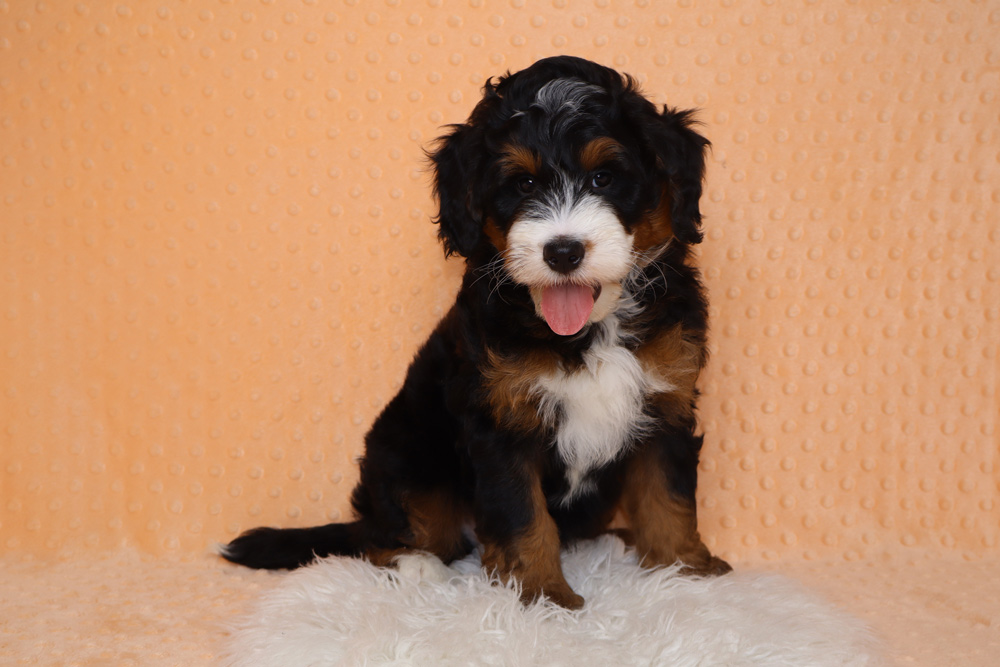
Mini Bernedoodle coat types trip up more buyers than just about any other topic we deal with here at Blue Diamond Family Pups. Most people start their search thinking about the look, then dig in and realize coat type also determines how much the dog sheds, how often they’ll need a groomer, and whether they can realistically keep up with it. The three types are wavy, curly, and straight. Each one behaves differently in daily life, and the differences matter more than most buyers expect before they bring a puppy home. We’ll cover all three here, from what actually drives coat type to how it changes in the first year your puppy is home.
We breed both F1 and F1B Mini Bernedoodles here on our 10-acre farm in Ohio, and we see all three coat types come through our litters regularly. Knowing how to identify coat type early, explain what it means to buyers, and match the right puppy to the right household has been part of our work here from the start. What follows comes from that.
The wavy coat is the one most people picture when they search for a Mini Bernedoodle, and for good reason. It sits somewhere between the straight hair of the Bernese Mountain Dog parent and the tight curl of the Poodle, producing soft, flowing waves that give the dog the classic Doodle look most families are after. Wavy coats shed very little. They also sit in a sweet spot for at-home maintenance, requiring regular brushing but far more forgiving of missed sessions than a curly is.
Curly coats are the most Poodle-like of the three, with tight ringlets running across the body that are closer in texture to what you’d see on a purebred Poodle than on a Bernese Mountain Dog. They shed the least of the three types and work best for households managing dog allergies, but they also demand the most brushing and mat the fastest when left without attention for more than a week.
The straight coat is the least common of the three in Mini Bernedoodles and the one that looks closest to the Bernese Mountain Dog parent. It lies flat against the body with little to no wave. Straight-coated Mini Bernedoodles shed more than their wavy or curly-coated littermates, which is something buyers chasing a low-shedding dog need to factor into their decision before they commit.
Coat type in a Mini Bernedoodle comes down to genetics, specifically which copy of the furnishing gene each puppy inherits from its mom and dad. The Poodle parent carries a dominant form of that marker, which controls the length and overall texture of the facial hair. The Bernese Mountain Dog parent carries the recessive form. How those two combine in each puppy determines whether the dog ends up wavy, curly, or flat. Two Poodle copies produce a tighter coat. With one from each, the result tends to land in the wavy range, which is what we see most often in our F1 litters since that’s exactly what a 50/50 cross produces.
Generation matters here because it shifts the odds. An F1 puppy, which is 50 percent of each breed, has a higher chance of landing wavy, while F1B dogs at 75 percent Poodle have more of that dominant form and come out curlier more often.
When families look at our listings, they’ll see that Kimberly notes coat type in her individual write-up on every puppy. We can usually read it by about four to six weeks of age. Curly coats show first. Those tight ring formations develop early and are easy to confirm by week four or five, while the wavy type usually clarifies by week six, when you can feel the wave setting in the body fur, and straight fur can sometimes take a bit longer to read with confidence.
We genetically test both parents on every pairing at Blue Diamond. Testing includes coat type markers, which give us a better starting point for predicting what a litter will produce before any puppy is even born. It still isn’t a guarantee. Genetics are probabilities, not promises, and litters still show variation even when the parent testing points in a clear direction.
Every Blue Diamond puppy listing includes Kimberly’s individual write-up, which notes coat type alongside temperament. If you want to know what coat type we’re seeing in a specific litter before you decide, just reach out.
All three coat types shed less than most dogs. That’s one of the things that draws families to the breed, but what low-shedding actually means varies depending on which type you end up with.
Curly coats shed the least, often close to nothing at all, after the puppy coat transitions out during the first year. Owners with a wavy Mini Bernedoodle will find a light amount of hair on furniture and clothing, though nothing close to what you’d see with a non-Doodle breed. Straight fur sheds more than either of the other two types. If you live with someone who has dog allergies, avoid it entirely. The puppy fur also sheds out in the first year, regardless of which type you have, which is why we tell every family that the first twelve months often produce more loose hair than they’ll ever see again from that dog.
Our breed page notes that shedding becomes very minimal after the first coat goes, and that matches what we hear from owners after their puppy turns one. Families often message us when their puppy turns ten or eleven months, saying their dog seems to be shedding barely at all. That’s the puppy coat finishing its transition.
For allergy-sensitive households, texture is the most important factor, more than generation or any other single variable. Curly is the safest choice. The tighter the texture, the less dander the coat releases into the air and onto surfaces, which is what actually causes reactions in allergy sufferers rather than the hair itself. Wavy works well for households with mild sensitivities, but it’s not the right pick when someone in the house reacts strongly to dogs.
We always recommend that anyone in your home with a real pet allergy spend time with a Mini Bernedoodle before committing to a puppy, regardless of coat type. No dog is fully hypoallergenic, and we’d rather have that conversation up front than have a family commit based on assumptions that didn’t hold.
The puppy you pick up at eight weeks is not the dog they’ll become. What they leave with will look noticeably different from the coat they’ll carry for the rest of their life, and the shift begins around the time they hit five months. It wraps up somewhere around their first birthday.
During the transition, which breeders sometimes call the ugly duckling phase, the coat can look patchy. The fur can be uneven or dull before it settles into its adult texture. Some dogs develop a temporary wave before their curl tightens. Others go through a softer, almost cottony phase before the adult coat comes in with its full texture and body. It can be alarming if you’re not expecting it. The adult coat is worth the wait, and it usually locks in and looks its best somewhere between ten and twelve months.
The actual type doesn’t change during the transition. A wavy dog doesn’t become curly and a straight dog doesn’t become wavy, but the texture, density, and length of the fur all shift noticeably as the adult comes in and the puppy fur sheds out. It’s really one layer pushing through while the other one exits. By twelve months, you’ll have a clear sense of what you’ve got for the long run.
Grooming effort depends on how tight the texture is. Curly coats need brushing more frequently. They also mat faster when sessions are skipped, and need trimming more often to keep the fur from building into dense, tangled layers that are uncomfortable for the dog and costly to sort out at the groomer. Wavy fur sits in the middle, needing regular attention but offering more room for error between groomer visits.
Straight coats are the easiest to maintain at home. They don’t mat as readily and the texture lays flat in a way that makes it easier to work through with a brush or comb, though you’ll still need to keep up with it to avoid tangles forming in the spots that get the most friction, like under the collar or behind the ears.
On our breed page, we recommend creating a grooming schedule every 12 to 16 weeks for Mini Bernedoodles. That’s a great starting point for wavy coats. While a curly fur puppy should be groomed closer to every eight weeks, especially once that adult fur is fully in, because tight texture builds density and traps debris faster than a wave does. We cover the full routine in our Mini Bernedoodle grooming guide, including what to brush with, how to get all the way to the skin, and how to prevent the matting that catches most owners off guard.
The right coat type depends on three things: your allergy situation, how much work you’ll put in at home between visits, and how you want the dog to look. None of the three is the right answer for everyone. When you’re looking at a specific puppy and want to know about that dog’s coat, or have questions about how a particular litter tends to produce, reach out and we’ll tell you exactly what we know.