
Standard Goldendoodle Puppies for Sale in Austin, TX
The Standard Goldendoodle is a 50 to 90 pound family dog and a designer cross of an English Cream Golden Retriever and a Standard Poodle. Many Goldendoodle breeders default to regular Golden Retrievers, but at Blue Diamond Family Pups we breed English Cream Golden Retrievers specifically because the lines run calmer. Adults stand 20 to 26 inches at maturity and live 10 to 15 years. The breed has three coat variations to choose from. F1 has the wavy coat, F1b the curlier low-shedding coat, and F1bb the fully hypoallergenic poodle coat. Our current pair of lines is F1 and F1b. In urban Austin and across hot humid South Central Texas, the breed stays indoors during peak afternoon heat. Standard Goldendoodle puppies for sale leave the farm vaccinated and microchipped.
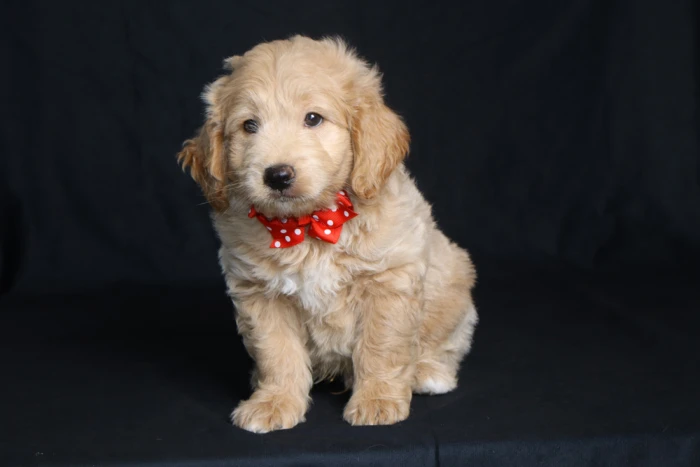
Available Standard Goldendoodle Puppies For Austin, TX
All Goldendoodle puppies displayed here can be delivered right to your door in Austin, TX.
Owning a Standard Goldendoodle in Austin
Daily activity for a Standard Goldendoodle in big-city Austin runs sixty to ninety minutes across the seasons. Two leash walks plus indoor play cover most days. Through hot humid Texas summers, exercise shifts to morning and evening hours when the air is cooler. Indoor AC time covers the worst afternoon stretches. Mental stimulation matters as much as miles, with the Poodle intelligence in the cross pulling toward variety in routes and routines. Mild winters mean year-round walks without much weather adjustment. Adults grow to 50 to 90 pounds and 20 to 26 inches at maturity. The breed fits apartments and condos with consistent walks. Yards help but aren't required for the breed. Standard Goldendoodles travel well in a car for family errands. A larger crate or back-seat setup makes the ride more comfortable on longer drives. Most pet-friendly stores welcome a leashed Standard Goldendoodle. The wavy or curly coat handles the hot humid climate well with cool-hour walks. Most Standard Goldendoodles live 10 to 15 years on regular care.
Is a Goldendoodle the Right Dog for Your Home?
A Standard Goldendoodle asks more of you than a lapdog does, and the families who are happiest with one know that going in. This is a dog that wants to move. It needs a real outlet, closer to an hour of activity a day, and gets restless and mouthy when it doesn’t get it. Households that hike, jog, throw a ball most evenings, or have a fenced yard and kids who run tend to get the best version of this dog. Park a bored Standard in a quiet condo with nobody home all day and you’ll meet the side of the breed that chews baseboards.
Know what you’re signing up for on size. A Standard Goldendoodle runs 50 to 90 pounds and carries itself like the retriever it is, a dog that leans its full weight into your leg and takes up half the couch. That heft is part of the appeal for a lot of buyers. It also means a dog strong enough to pull you off your feet on a leash before it learns its manners, and one that needs floor space, a vehicle it actually fits in, and a household that wanted a big dog in the first place. A family with a big yard and three teenagers is the natural fit here.
The Golden Retriever half of the cross is doing a lot of the heavy lifting on temperament. Goldens were worked for generations as bird dogs, fetching and bringing back without a hard mouth, and that breeding shows up as a people-pleasing streak that makes the Standard Goldendoodle one of the easier large dogs to train. They read your tone. They want the job done right. Recall, crate work, basic manners, and the early steps of service or therapy work all come faster with this breed than with most. Owners coming off a stubborn terrier or a bored hound notice the contrast inside the first month.
Every Goldendoodle we place is an F1b. That label describes a first-generation Goldendoodle bred back to a Poodle, and the practical payoff is the coat. A straight first-cross can throw puppies anywhere from flat-and-shedding to tightly curled, and you don’t know which you’ve got until the puppy coat blows out. Looping that first cross back to a Poodle stacks the odds toward a wavy or curly coat that holds onto its hair instead of dropping it across your floors. For a home where somebody reacts to dander, that extra Poodle in the mix is the difference between a dog that works and a dog that gets rehomed. You keep the retriever brain and the retriever warmth and trade away most of the shedding.
Plan on a coated dog living 10 to 15 years. A child who is seven when the puppy arrives will be driving by the time that dog slows down. That is a long runway. Be honest with yourself about whether the energy level that charms you in a puppy still fits your life eight or ten years out.
The thing that catches new owners off guard isn’t the training or the exercise. It’s the upkeep on a curly coat at this size. A Standard carries a heavy coat, and a matted 70-pound dog is a real job to put right, both for your wallet at the groomer and for the dog living under all that felted hair. Brush to the skin a few times a week, not only across the surface, because the mats that matter form underneath where a quick once-over never reaches. Keep the grooming appointments steady rather than waiting until the coat is already a project. Owners who build the routine in from week one rarely fight it later. The ones who let it slide learn the hard way that a neglected doodle coat sometimes has to be shaved down to start over.
Getting Outside in Austin With your Standard Goldendoodle
| Region | South Central Texas |
|---|---|
| Near | Texas blackland prairie |
| Elevation | 633 ft |
| Local Climate | warm humid summers and mild winters |
| January Average High | 59°F |
| July Average High | 94°F |
| Sunny Days Per Year | 232 |
| Annual Rainfall | 52.0 inches |
| Annual Snowfall | a few inches |
A Standard Goldendoodle adapts comfortably to Austin family life. The 50 to 90 pound and 20 to 26 inch adult range is typical of the breed at maturity. The size works well across South Central Texas urban settings, whether the household is in a downtown apartment or further out where homes have more room. Daily activity comes to sixty to ninety minutes. Two walks plus a play session handle that easily. The Poodle side of the cross shows up early in puppyhood with quick learning. The breed picks up routines fast, takes to training easily, and benefits from a little mental engagement on top of daily exercise.
Hot humid weather sets the rhythm in Austin for a Standard Goldendoodle's outdoor routine through the year's warmer months. We recommend walks shifted to dawn and dusk during peak summer, plus a pavement check before each summer outing for paw safety on city sidewalks. AC time inside covers the worst afternoon stretches. Spring rain comes off the coat easily with a towel at the entryway. Mild winters mean year-round outdoor walks across the city without much weather adjustment. Fall is the easiest stretch of the year with mild air and comfortable temperatures.
Local Dog Parks and Trails
Varied routes matter for a Standard Goldendoodle's curious Poodle side, and families in Austin build that variety naturally into the daily walking routine. Red Bud Isle Dog Park at 3401 Red Bud Trail, Austin and Auditorium Shores Off-Leash Area at 900 W Riverside Dr, Austin suit the daily exercise. Ann & Roy Butler Hike & Bike Trail at Lady Bird Lake, 900 W Riverside Dr, Austin and Barton Creek Greenbelt at 2201 Barton Springs Rd, Austin handle the longer walks that extend the routine.
Family routine in Austin works naturally for a Standard Goldendoodle. It only takes a few weeks for the dog to settle in. Morning walks, calm indoor stretches through the workday, and weekend outings build the rhythm this breed settles into easily as part of household life.
Why Families Choose Blue Diamond Family Pups for Their Standard Goldendoodle
Seven People, Five Children, and Our Puppy Trainer's Temperament Test of Every Puppy
A Goldendoodle raised right will be the easiest dog you ever own, and a Goldendoodle raised wrong will test your patience for the next decade or more. The difference shows up early. How a puppy reacts to being startled, whether it recovers fast or stays rattled, how it reads a stranger walking through the door, and how steady it stays when the house gets loud all trace back to a short stretch in the first weeks of life. That stretch is when the nervous system takes its shape. Blue Diamond runs Early Neurological Stimulation on every Goldendoodle puppy from day three to day sixteen, a set of short daily handling exercises timed to the window when a puppy’s stress response is still being wired. Researchers built the original protocol for military and service dogs that had to stay level under real pressure. Plenty of breeders raising family pets never bother with it. We’ve watched the difference it makes in the grown dog and won’t raise a litter without it.
Dean and Esther farm 10 acres in Sugar Creek, Ohio, and their five kids are hands-on with every litter from the moment the puppies start moving around. A Goldendoodle is happiest with a job, and that job is usually you. A puppy that meets only one quiet adult for two months turns out wired differently than one that’s been handled, carried, and chased around the yard by kids of all ages since its eyes opened. Our puppies grow up inside the noise of a working farm and a full house. Cattle in the field, the horse, doors banging, a vacuum running down the hall, kids thundering through the kitchen. By eight weeks, a slammed cabinet doesn’t lift their head anymore. Your first week home won’t be their first taste of a busy life.
Our certified trainer sits down with each Goldendoodle puppy before its photo ever goes on the site. They don’t recycle one paragraph across the whole litter. They watch the individual dog and write up what they see. Does it go still or squirm when they lift it. Does a dropped pan send it bolting or does it trot over to investigate. Will it shadow them around the room or pick a corner and entertain itself. How fast does it come down off a burst of play. What you read on the listing is that write-up, the real dog, not a stock description of the breed with a cute picture stapled to it.
That distinction earns its keep with Goldendoodles, because the spread inside one litter is wider than most buyers expect. People hear “Goldendoodle” and picture a single happy golden teddy bear, and the breed does lean friendly. But friendly comes in flavors. One pup will be the velcro extrovert who meets every guest at the door and flops belly-up for anyone willing to scratch it. A littermate from the same parents can be cooler at the front door, pick its people carefully, and turn into the dog that parks itself under your desk all day and asks for nothing. A house with three loud kids and a revolving door of company will click with the first dog. Someone who works from home and wants a calm shadow may be far happier with the second. Ranking one above the other misses the point. They’re built for different homes, and our puppy trainer’s notes exist to match the puppy to your life instead of to whichever one looked best on camera.
Both parents behind every Goldendoodle litter, the Golden Retriever and the Poodle, get health tested and genetically screened before any breeding happens, and the results live on each parent’s profile page. Goldendoodles pull from both gene pools. Hip and elbow problems can ride in on the Golden Retriever side, and certain eye conditions come down the Poodle line. The screening catches what it can before a pairing is ever made. You read the panels yourself and go in knowing what’s behind the puppy. Every Goldendoodle leaves with current shots, deworming done, a microchip, a full exam from Sugar Creek Veterinary Clinic, and a one year health guarantee. If you want the move home to go smoother, add a Heartbeat Puppy Pal, a soft toy the litter has been piling on top of for weeks, so it shows up smelling like the brothers and sisters your puppy just left.
One more thing worth knowing. Blue Diamond works with a small handpicked group of Ohio breeders, and they don’t get a softer version of the rulebook. Same ENS schedule down to the day. Same health and genetic panels on the parent dogs. Same trip to our puppy trainer for an honest evaluation before anything gets posted. A Goldendoodle bought through us runs the identical gauntlet from birth to going-home day regardless of which farm raised the litter.
Nearby Cities
If you are not located directly in Austin, that is not a problem. Blue Diamond delivers and sells Goldendoodle puppies to families throughout the South Central Texas, including Barton Creek TX, Bee Cave TX, Garfield TX, Hornsby Bend TX, Lost Creek TX, Rollingwood TX, Shady Hollow TX, Sunset Valley TX, West Lake Hills TX, and Wyldwood TX.
We raise more than just Goldendoodle puppies. See all of our breeds and puppies in Austin.
Find Goldendoodle Puppies In Major Cities Near You:
Find Goldendoodle Puppies In Local Communities
Getting Your Goldendoodle Puppy to Austin, Texas
The question we hear most from Austin families looking at puppies for sale is a fair one. Who is actually with the dog on a trip that long. You're 22 to 24 hours from us, and the honest answer is that two drivers are, the whole way.
Our vans pull out of Ohio every Tuesday, custom built and climate controlled. A pair of drivers rides every route and trades off, so the van keeps moving and nobody is stretched thin behind the wheel. They stop on a schedule for potty breaks and to look each puppy over, they send updates from the road, and they phone ahead with a firm arrival time before they reach you. Each puppy rides in a custom carrier built right into the van, with its own ventilation, never a cargo hold. Door to door to Austin is $400. About 95 percent of our puppies go home this way, cross country included, so it's routine for us. If you'd rather have your puppy sooner, a flight nanny flies it in the cabin for $800 to $900.
Both parents are health and genetic tested and clear of hereditary disease, and a certified trainer profiles every puppy before it lists. Depending on the breed, a puppy runs $2,195 to $4,595. By July the highs sit in the mid 90s, so once your puppy is home, plan walks for the cool ends of the day and let it wait out the hottest hours inside.
See What Our Puppy Parents Have To Say Near You!

